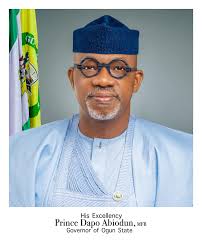
A comment attributed to Ogun State Governor, Dapo Abiodun, describing critics of his administration as “barking dogs” has continued to generate reactions across the state, particularly among residents of Ijoko and Ota, who say the remark reflects what they describe as a growing disconnect between government and citizens’ daily realities.
The comment, which surfaced amid rising public criticism of governance in parts of the state, has drawn attention to long-standing infrastructure and security challenges in the two densely populated communities.
Ijoko, a major residential and commercial area with a large population of traders, artisans, civil servants and commuters, has for years struggled with insecurity. Residents report frequent incidents of theft and robbery, including phone snatching in daylight and break-ins at night. Many attribute the situation to the absence of a properly equipped and accessible police station, forcing communities to rely largely on vigilante groups and informal security arrangements.
Road infrastructure in Ijoko remains another concern. Several internal roads are severely damaged, with deep potholes and erosion worsening during the rainy season. The condition of the roads has affected transportation, increased vehicle maintenance costs, raised fares, and disrupted school and commercial activities. Residents say emergency response is often delayed due to poor access.
Ota, regarded as one of Ogun State’s industrial centres, faces similar challenges. Key access roads into and out of the city are in poor condition, contributing to traffic congestion and road accidents. Workers and business owners report loss of productive hours as a result of persistent gridlock.
Healthcare access has also been highlighted as a concern in Ota. Residents say functional ambulances are either inadequate or unavailable, leaving families to transport emergency patients using private or commercial vehicles. Electricity supply remains inconsistent, water access unreliable, and drainage infrastructure poorly maintained, resulting in flooding after moderate rainfall.
The governor’s alleged remark has intensified public debate, with critics arguing that such language undermines the legitimacy of citizen complaints. Supporters of the administration, however, have downplayed the controversy, describing it as a misinterpretation or politically motivated reaction.
Some residents have drawn comparisons between the current administration and that of former Governor Ibikunle Amosun, citing what they describe as more visible infrastructure development during the previous government. They argue that road conditions and security have deteriorated in several areas in recent years.
There is also a growing public perception that political leaders are insulated from the challenges faced by ordinary citizens, a view reinforced by what residents describe as limited engagement with grassroots communities. Analysts note that such perceptions, whether accurate or not, often gain traction in the absence of visible intervention and clear communication.
As public discussion continues, residents of Ijoko and Ota say their concerns go beyond political rhetoric. They insist their grievances are rooted in everyday experiences of insecurity, poor infrastructure, and limited access to basic services.
Observers say how the state government responds to both the criticism and the underlying issues may shape public confidence in governance ahead of future political cycles.