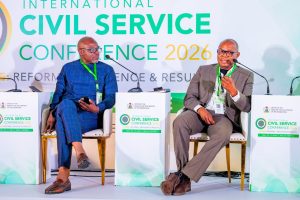
 The Director General of the National Information Technology Development Agency (NITDA), Kashifu Inuwa, has advocated the responsible adoption of Artificial Intelligence (AI) across public institutions, stressing the need for strong governance frameworks, human accountability, and continuous digital skills development.
Speaking at the International Civil Service Conference (ICSC) 2026 held at Eagle Square, Abuja, the NITDA DG, represented by the Director of Stakeholder Management and Partnerships, Dr. Aristotle Onumo, revealed that the Agency has commenced the implementation of a comprehensive three-year AI Transformation Plan aimed at repositioning NITDA into a fully digital and highly efficient institution.
According to him, the initiative is designed to ensure institutional continuity, operational efficiency, and seamless workflow management, regardless of staff changes within the Agency.
“In NITDA, we have what we call the AI Transformation Plan a strategic three-year initiative put in place to ensure that even if the current workforce changes completely, incoming personnel can easily integrate into the system and continue operations without disruption,” he stated.
He disclosed that the Agency has already integrated AI into several internal operations, particularly document processing and workflow management. He explained that official documents submitted at the Agency are now digitally scanned at the point of entry and automatically routed by AI systems to the relevant departments and officers using keyword recognition and subject analysis.
According to him, the system also tracks response timelines and flags unattended documents whenever delays occur beyond approved timelines.
“All that is required is to submit documents at the gate. The AI system scans, analyses, and routes them to the responsible officers. Where documents are not treated within the stipulated timeframe, the system automatically flags and escalates them,” he explained.
Addressing growing concerns about AI replacing human jobs, the NITDA boss clarified that Artificial Intelligence should be viewed as an enabler of productivity and innovation rather than a threat to human relevance.
“There is a common fear that AI will eliminate jobs, especially within the public service. However, the real challenge will affect those unwilling to adapt and upgrade their skills. Individuals who embrace learning and retraining will benefit greatly from the opportunities AI presents,” he said.
He further disclosed that NITDA has already commenced extensive AI capacity-building programmes for its workforce, noting that staff members whose traditional roles are being transformed by automation are now being reassigned into emerging AI-related responsibilities.
“We have ensured that every member of staff undergoes AI training. Personnel previously involved in manual file management have now been redesignated into roles such as AI assistants and AI administrators. Our focus is on preparing the workforce for the future, not replacing them,” he noted.
The DG also stressed the importance of maintaining human oversight in every AI deployment process, warning against the total removal of human intelligence and accountability from governance systems.
“No matter how advanced AI becomes, human monitoring and accountability must remain central. At the end of the day, someone must be responsible for decisions and outcomes,” he cautioned.
On governance and regulation, he urged Ministries, Departments, and Agencies (MDAs) to develop clear internal AI policies capable of defining operational boundaries and ethical standards for AI usage within government institutions.
He noted that AI deployment in government requires stricter accountability than in the private sector because public institutions must answer directly to citizens for any misuse, ethical breaches, or operational failures associated with the technology.
“We must ensure that AI deployment aligns with data protection laws and responsible usage principles. Without strong governance frameworks, the risks of data misuse and abuse could become more widespread and damaging,” he warned.
Highlighting NITDA’s broader national AI agenda, the DG referenced the Agency’s role in developing Nigeria’s National AI Strategy, describing it as one of the country’s most forward-looking digital policy initiatives.
He added that NITDA is currently serving as a practical AI sandbox for testing implementation models that could later be replicated across the wider public service ecosystem.
As part of efforts to strengthen digital competencies within government institutions, he disclosed that the Agency is collaborating with the Office of the Head of Civil Service of the Federation to train civil servants in digital literacy and AI-related skills.
Reiterating the importance of adaptability in the future of work, the NITDA DG maintained that continuous learning remains critical for survival in an increasingly AI-driven global economy.
“AI has not come to completely replace humans. However, individuals who fail to develop relevant digital and AI skills may find it difficult to remain relevant within the evolving technology ecosystem,” he concluded.