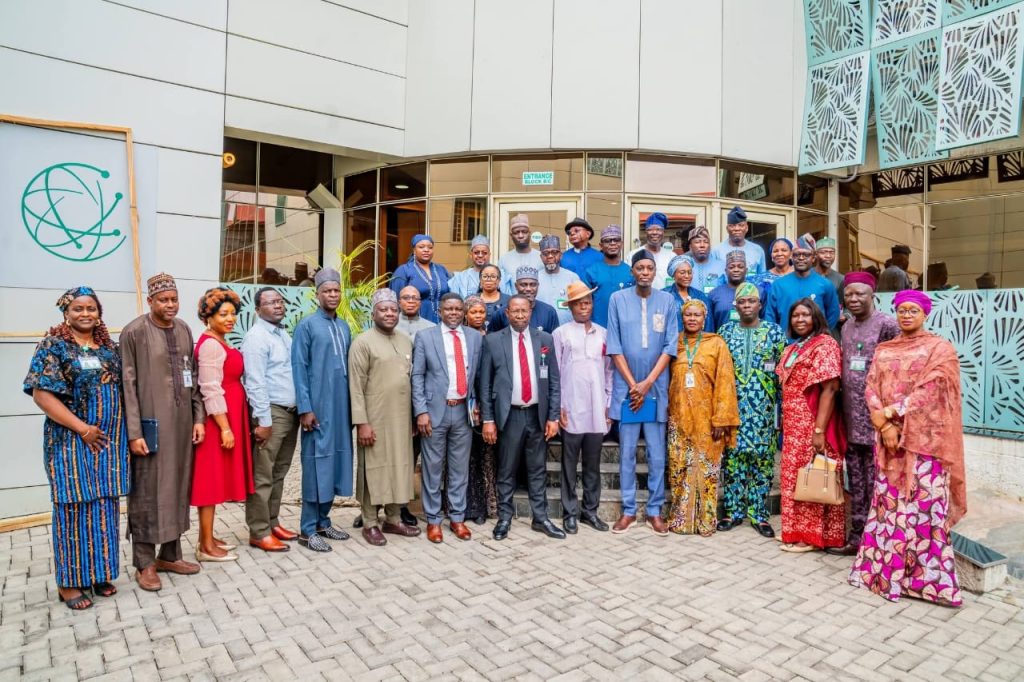
 The Director General of the National Information Technology Development Agency (NITDA), Kashifu Inuwa, has emphasised the critical role of collaboration between government institutions and emerging startups in driving Nigeria’s digital transformation and overall national development.
Speaking at the Nigerian Satellite Week 2026 in Abuja, themed “Harnessing Space Technology for an Extraordinary Nigeria,” Inuwa urged stakeholders across sectors to embrace partnerships as a powerful tool for innovation and sustainable impact.
“Take a good step, and you can make a difference,” he stated, stressing the need to translate innovative ideas into tangible outcomes through collective action.
Represented by the Director of Stakeholder Management and Partnerships, Aristotle Onumo, the NITDA boss delivered a presentation titled “Enhancing Collaboration Between Government Agencies and Emerging Start-ups.” He outlined four key principles for driving transformation: enabling ecosystems rather than controlling them; prioritising networks over rigid institutions; fostering talent alongside innovation; and focusing on scalable platforms instead of isolated projects.
Highlighting the real-world impact of digital innovation, Inuwa shared the story of a rural farmer who overcame productivity challenges through access to digital tools and networks. He noted that such small-scale interventions can expand into significant economic gains and contribute to national infrastructure, including satellite technology.
“This demonstrates the power of space technology and underscores the importance of platforms like this event,” he said.
Inuwa further noted that startups are increasingly leading innovation in areas such as telecommunications, navigation, security, and cloud services. Once dominated by global superpowers, the space sector is now evolving into a major economic driver, with Nigeria’s “Sunrise Packet” projected to contribute over $1.5 billion to the economy by 2030.
“Innovation without adoption is wasted,” he added, highlighting the need for government to create enabling policies, infrastructure, and incentives that allow startups to scale effectively.
He explained that modern regulatory approaches should focus on market creation, ecosystem coordination, and public value delivery rather than restricting innovation. He also pointed to key initiatives such as the Digital Start-Up Act, Idea Hatch, and the National Digital Leadership Programme, all aimed at empowering young innovators and connecting them to global opportunities.
Additionally, platforms like GITEX Africa, GITEX Nigeria, and Digital Nigeria were identified as critical avenues for showcasing startups, attracting investment, and fostering mentorship.
Inuwa concluded with a strong call for synergy among government, startups, non-governmental organisations, and investors, describing Nigeria’s youthful population as its greatest asset.
“If we are to build a truly digital Nigeria, collaboration is not optional—it is essential,” he said.
Also speaking at the event, the Minister of Communications, Innovation and Digital Economy, Bosun Tijani, described Nigeria’s satellite infrastructure as pivotal to the nation’s digital future.
“Nigeria is the only West African country with its own satellite. Nigerian Communications Satellite Limited provides critical connectivity and resilience, not just for Nigeria but for the entire region,” he noted.
Tijani revealed that President Bola Ahmed Tinubu has approved the acquisition of NigComSat-2A and NigComSat-2B, a move expected to significantly boost Nigeria’s space capabilities.
However, he stressed that infrastructure alone is insufficient.
“What truly matters is how we apply this technology to improve agriculture, education, security, and business operations,” he said.
The Minister also highlighted major government investments, including a ₦12 billion digital economy research cluster fund under Project Bridge. He added that Nigeria is expanding its digital backbone through 90,000 kilometres of fibre optic cables, nearly 4,000 telecom towers in underserved communities, and new satellite deployments to strengthen regional connectivity across countries such as Cameroon, Niger, Chad, Burkina Faso, and the Republic of Benin.
“The talent, ideas, and energy are all here in Nigeria. The responsibility lies with us to translate them into real impact for our people and economy,” Tijani added.
The Nigerian Satellite Week continues to serve as a strategic platform for collaboration among government, academia, startups, and the private sector, reinforcing Nigeria’s leadership in Africa’s digital and space economy.
In her welcome remarks, the Managing Director of Nigerian Communications Satellite Limited, Jane Nkechi Egerton-Ideyen, stated that Nigeria’s space programme is entering a new phase marked by deliberate and focused growth.
She highlighted improved institutional capacity, stronger partnerships, and measurable economic gains, noting that the agency’s revenue grew from less than $650 million in 2023 to over $2 billion in 2025. This growth, she said, is driven by key reforms, new commercial deals, and increasing demand for satellite broadband services across Africa.
Egerton-Ideyen further revealed that Nigeria has launched seven space assets in just over two decades and is now shifting focus from prestige-driven projects to practical outcomes enhancing connectivity, improving livelihoods, and promoting inclusive development.
She also disclosed that over 500 young Nigerians were trained in satellite technology in the past year, while more than 50 startups have benefited from NIGCOMSAT’s accelerator programme.