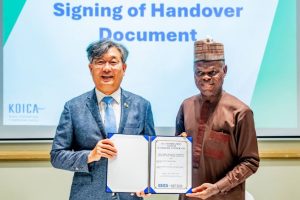
Nigeria has taken a significant step forward in its digital transformation journey as the National Information Technology Development Agency (NITDA) officially assumes control of the Nigeria Government Enterprise Architecture (NGEA) Portal.
At a formal handover ceremony held at the Continental Hotel in Abuja, the Director-General of NITDA, Kashifu Inuwa Abdullahi represented by the Director of Corporate Planning and Strategy, Dimie Warowei—described the development as a major milestone in advancing Nigeria’s digital governance framework. He noted that the initiative is the result of a strategic collaboration between Nigeria and the Republic of Korea, with support from the Korea International Cooperation Agency (KOICA).
Launched in late 2022, the NGEA initiative forms a critical part of Nigeria’s e-Government Masterplan 2.0. It is designed to modernise public sector digital infrastructure by promoting system integration, standardisation, and improved coordination across government institutions.
 Over the past two and a half years, Nigerian and Korean experts have worked together to enhance the country’s enterprise architecture framework. This collaboration has produced a refined structure aimed at boosting interoperability, operational efficiency, and alignment with national development priorities.
As part of the project, key reference models—including Technology, Business, and Service models—have been developed to guide implementation across ministries, departments, and agencies (MDAs). Additional Data and Performance Reference Models are also in progress to further strengthen the framework.
Pilot implementations were carried out in major institutions such as the National Identity Management Commission, the Nigeria Customs Service, and the Nigeria Immigration Service, as well as within NITDA. These agencies benefited from targeted capacity-building programmes and tailored digital transformation roadmaps.
Supporting infrastructure for the portal was deployed by Qorebox Technologies Limited and is hosted on the platform of Galaxy Backbone, with a two-year maintenance plan to ensure stability and sustainability.
Abdullahi emphasised that the NGEA Portal goes beyond being a digital tool, describing it as a foundational platform for a more coordinated, efficient, and citizen-centric government. He noted that widespread adoption of enterprise architecture will help eliminate duplication, enhance interoperability, and improve service delivery across the public sector.
He also expressed gratitude to the Korean government and KOICA for their continued technical and strategic support, while reaffirming NITDA’s commitment to scaling the framework nationwide.
In his remarks, KOICA Country Director, Eunsub Kim, described the handover as a testament to the success of the partnership between KOICA and NITDA, reiterating the agency’s commitment to supporting Nigeria’s digital transformation agenda.
Similarly, the Permanent Secretary of the Federal Ministry of Communications, Innovation and Digital Economy, Nadungu Gagare—represented by Johnson Bareyei—highlighted that the NGEA Portal marks a shift from fragmented digital initiatives to a unified national framework. He noted that the achievement aligns with the ministry’s broader transformation agenda under the leadership of Bosun Tijani.
With the handover complete, NITDA is now positioned to lead the operational management and long-term sustainability of the NGEA Portal, reinforcing Nigeria’s commitment to building a more digitally driven and efficient public sector.