
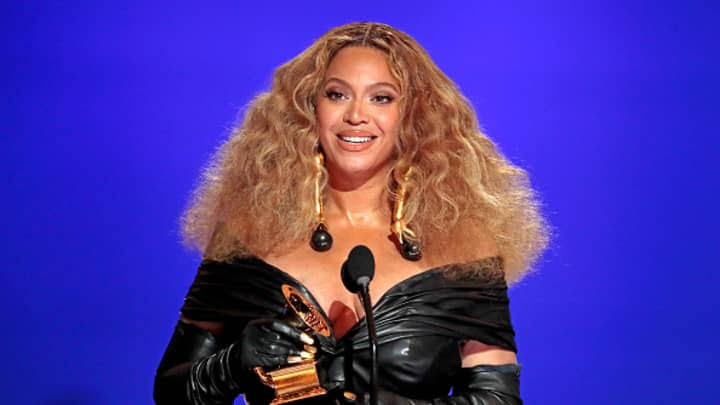

In a music industry where longevity is rare and sustained critical dominance is rarer still, Beyoncé Giselle Knowles-Carter has once again redrawn the boundaries of artistic achievement. Following the official unveiling of nominees for the 69th Annual Grammy Awards, the American singer, songwriter, and actress etched her name even deeper into Recording Academy history by becoming the first artist ever to reach 100 career Grammy nominations.
The landmark century milestone arrived via a nod in the Best R&B Solo Performance category for her acclaimed 2026 single, “Morning Dew (Donk)”. Already holding the all-time record with 35 Grammy wins to her name, Beyoncé’s 100th nomination cements her unrivaled standing as both the most-nominated and most-awarded artist in the history of music’s most prestigious institution.
For an artist whose career has spanned nearly three decades from her breakout rise in the late 1990s with Destiny’s Child to her reign as a genre-defying solo visionary the triple-digit nomination milestone represents far more than a statistical triumph. It stands as a testament to relentless creative evolution, vocal mastery, and an unmatched ability to command both popular culture and critical acclaim across eras.
The Milestone Track: “Morning Dew (Donk)”
At the center of this historic moment is “Morning Dew (Donk)”, Beyoncé’s 2026 single that earned her recognition in the Best R&B Solo Performance field. Throughout her career, Beyoncé has consistently refused to be confined to a single sonic lane—moving seamlessly across pop, hip-hop, dance, Afrobeats-infused rhythms, and country yet R&B remains the foundational bedrock of her artistry.
With “Morning Dew (Donk)”, she returns to the genre that first introduced her powerhouse vocals to the world, reminding listeners and Recording Academy voters alike of her technical precision and emotional command. Earning her 100th career nomination in an R&B vocal performance category carries a poetic symmetry: nearly thirty years after her first Grammy recognition as part of Destiny’s Child, her voice itself remains the primary instrument driving her historic momentum.
While the 100-nomination milestone is a solo triumph in history books, the race for the Best R&B Solo Performance trophy at the 69th Grammy Awards pits Beyoncé against a formidable lineup of contemporary vocalists, celebrated veterans, and global stars.
Sharing the category ballot alongside Beyoncé are:
-
Kehlani: Known for her smooth, emotionally candid approach to modern R&B and consistent critical praise.
-
Victoria Monét: A multi-Grammy-winning singer and songwriter whose refined vocal styling and meticulous production have made her a perennial Academy favorite.
-
Jill Scott: A revered neo-soul icon whose rich storytelling and timeless vocal authority represent the classic lineage of R&B excellence.
-
Tems: The globally acclaimed Nigerian singer-songwriter whose distinctive alt-R&B sound and international crossover success continue to bridge African and global music landscapes.
The inclusion of Tems alongside American R&B stalwarts underscores the increasingly borderless nature of contemporary R&B, setting up one of the most competitive and culturally resonant matchups of the 69th Grammy ceremony. For Beyoncé, competing in a category that spans neo-soul royalty like Jill Scott and modern global trailblazers like Tems highlights her unique position as a bridge across generations of Black music.
Three Decades of Unprecedented Grammy Dominance
To appreciate the sheer scale of 100 Grammy nominations, one has to look at the broader history of the Recording Academy. Since the awards began in 1959, hundreds of legendary musicians, composers, and producers have built storied careers without ever coming close to triple-digit recognition. Reaching 100 nominations requires not merely a peak era of commercial dominance, but decades of consistent album cycles, boundary-pushing collaborations, visual projects, and genre-spanning experimentation.
Beyoncé’s Grammy journey began at the turn of the millennium with Destiny’s Child, earning early accolades for era-defining hits like “Say My Name” and “Survivor”. When she launched her solo career with 2003’s Dangerously in Love, she immediately swept five trophies in a single night establishing a pace that virtually never slowed down.
Across subsequent landmark projects including B’Day, I Am… Sasha Fierce, 4, her self-titled 2013 visual album BEYONCÉ, Lemonade, Renaissance, and Cowboy Carter she continually expanded what an album rollout and sonic concept could achieve. Along the way, she shattered long-standing records, surpassing classical conductor Sir Georg Solti’s 31-win record to become the most-awarded artist in Grammy history, and tying before ultimately surpassing all previous nomination benchmarks.
Now, with 35 wins and an unprecedented 100 nominations, Beyoncé operates in a statistical stratosphere entirely her own.
Beyond the trophies and historical metrics, Beyoncé’s achievement resonates because of how she has navigated the intersection of public artistry and personal life. As a mother of three and a global cultural icon, she has increasingly structured her career around deliberate, high-impact artistic statements rather than constant media saturation.
Each release whether a full-length conceptual album or a focused single like “Morning Dew (Donk)” arrives as a cultural event, crafted with meticulous attention to musical heritage, vocal arrangement, and sonic innovation. By refusing to rely on nostalgia or formulaic pop trends, she has kept Recording Academy voters engaged across shifting musical landscapes, proving that commercial relevance and high artistic ambition do not have to be mutually exclusive.
What Comes Next at the 69th Grammy Awards
As music fans and industry insiders look ahead to the 69th Annual Grammy Awards ceremony, all eyes will naturally turn to whether Beyoncé converts her historic 100th nomination into her 36th golden gramophone. Regardless of the final envelope on awards night, the milestone itself is already permanent.
Becoming the first artist in history to secure 100 Grammy nominations is more than a personal victory for Beyoncé Giselle Knowles-Carter it is a defining benchmark in modern music history, setting a standard of excellence that future generations of artists will measure themselves against for decades to come