
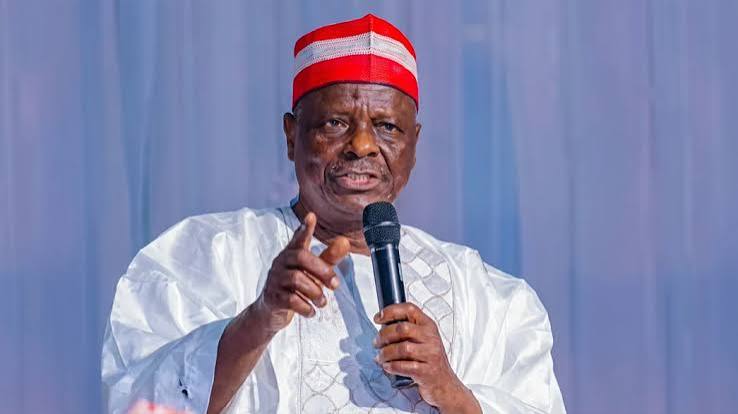
Rabiu Kwankwaso, the vice-presidential candidate of the National Democratic Congress (NDC), has accused Kano State Governor Abba Yusuf of orchestrating a political smear campaign against him using Nigeria’s anti-corruption agency, the Economic and Financial Crimes Commission (EFCC).
In a statement released on Friday, Kwankwaso—a former governor of Kano State and Yusuf’s one-time political mentor—alleged that the sitting governor is attempting to damage his nearly five-decade public reputation ahead of the 2027 general elections.
The Kano State Government has strongly rejected the accusations, dismissing them as misleading and politically motivated.
Allegations of Political Weaponisation
According to Kwankwaso, Governor Yusuf personally submitted a formal petition to the EFCC several months ago requesting an investigation into his affairs. Kwankwaso claimed that when the anti-graft commission declined to act on the request due to its institutional procedures, the governor turned to external pressure groups.
“It is on this basis that I believe he is determined to drag me and my family into public controversy by leveraging reputable government agencies, particularly the EFCC, in an attempt to tarnish the public image I have spent nearly fifty years building,” Kwankwaso stated.
He specifically pointed to a little-known civil society group, the Society for Anti-Corruption and Good Governance Initiative (SACGGI), alleging that the organisation was mobilised to stage demonstrations at the EFCC headquarters in Abuja to force the agency’s hand.
Beyond institutional pressure, the NDC vice-presidential candidate accused Yusuf and unnamed members of the Kano State cabinet of conducting a coordinated media campaign. He alleged that selective and misleading information is being leaked to public platforms to cast him in a negative light and distract voters from substantive governance issues as the 2027 electioneering season approaches.
“Coming as it does within the context of the electioneering season, these actions appear calculated to distract attention from substantive issues, undermine our credibility, and weaken our capacity to contest and win elections in 2027,” he said.
Dispute Extends to Kano Governorship Race
Kwankwaso further alleged that the political friction is not limited to his own national ambitions, claiming that the state government is also attempting to obstruct the candidacy of Aminu Abdussalam, the NDC’s governorship candidate in Kano State.
He accused the governor of trying to exert influence over the Independent National Electoral Commission (INEC) and the judiciary to prevent Abdussalam’s name from being published on the final list of candidates.
“This constitutes a further attempt by the Governor to manipulate elements within reputable institutions, INEC and the judiciary, to prevent the publication of our candidate’s name and ultimately bar him from contesting the 2027 general election, so that the Governor may run unopposed,” Kwankwaso alleged.
Kano State Government Denies Involvement
Responding on Friday, the Kano State Government distanced itself entirely from Kwankwaso’s ongoing engagements with the anti-corruption agency.
In an official statement signed by the Commissioner for Information and Internal Affairs, Sunusi Bature Dawakin Tofa, the administration stated that Kwankwaso’s interactions with the EFCC predated Governor Yusuf’s assumption of office. The government described the former governor’s assertions as an attempt to shift blame and politicise standard anti-corruption processes.
Furthermore, the state government maintained that it has no hand in the internal party crises or ongoing court cases affecting the National Democratic Congress, insisting that Governor Yusuf remains focused on state governance rather than political interference.
Defending a Public Service Record
In his statement, Kwankwaso defended his integrity across decades of public service, noting that he has maintained a clean record more than eleven years after completing two full terms as Governor of Kano State. He also highlighted his past roles as Minister of Defence, Senator, Deputy Speaker of the House of Representatives, and seventeen years in the civil service.
He commended the EFCC for what he described as its professional conduct during two previous invitations extended to him in the past, urging political leaders to respect the independence of state institutions. Offering a cautionary note to current officeholders, Kwankwaso remarked: “Public office is transient; those who live in glass houses should be careful about throwing stones.”
Background to the Rift
Kwankwaso’s remarks come just days after members of the Society for Anti-Corruption and Good Governance Initiative staged a protest at the EFCC headquarters in Abuja on November 25. During the demonstration, the group submitted a formal petition urging the commission to investigate properties allegedly linked to Kwankwaso across Abuja, Kano, and Nasarawa states, while calling for a comprehensive lifestyle audit and an examination of his asset declarations.
Receiving the petition on behalf of the commission, the EFCC’s Chief of Staff, Michael Nzekwe, assured the demonstrators that the matter would be reviewed on its merits and handled in accordance with professional standards.
The public exchange underscores a deepening political rupture between two figures who were once close allies. Yusuf previously served under Kwankwaso in several capacities, including as personal assistant, principal private secretary, and state commissioner. With Kwankwaso’s backing, Yusuf won the 2023 Kano governorship election on the platform of the New Nigeria Peoples Party (NNPP). However, the alliance fractured following Yusuf’s defection to the ruling All Progressives Congress (APC) in January 2026, setting the stage for a fierce political contest in Kano State ahead of the 2027 polls.