
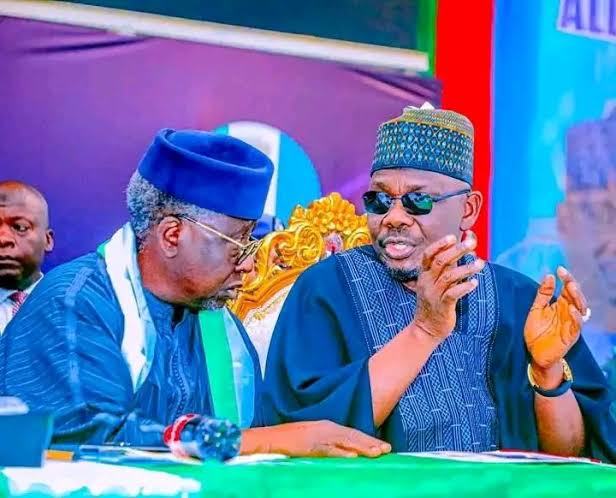
Political and legal tensions in Nasarawa State have escalated sharply following a formal demand by former Governor Umaru Tanko Al-Makura for an immediate retraction and an unreserved public apology from the Secretary to the State Government (SSG), Dr. Labaran Shuaibu Magaji, SAN. The legal notice stems from an official state government publication that linked the two-term former governor to the alleged sponsorship of a disruption during Vice-President Kashim Shettima’s recent visit to the state capital, Lafia.
Conveyed in a formal letter dated November 12, 2026, and addressed to the SSG at the Government House in Lafia, the pre-action notice was executed on Al-Makura’s behalf by his legal counsel, Malla Makpa, Esq. Giving the state government a strict seven-day window to comply, the former governor warned that failure to retract the statement and apologize publicly will trigger civil defamation proceedings and criminal cybercrime complaints without further notice.
Background: The November 4 State Government Statement
The dispute originates from a press release issued by the Office of the Secretary to the Government of Nasarawa State on November 4, 2026, in the wake of unrest reported during Vice-President Kashim Shettima’s visit to Lafia, which included a courtesy visit to the Emir of Lafia and surrounding political activities.
In addressing the incident, the state government’s statement provoked immediate controversy across Nasarawa’s political landscape drawing sharp reactions from opposition stakeholders, including the Social Democratic Party (SDP), and civil groups who urged security agencies to conduct an impartial investigation rather than trade political accusations.
According to Al-Makura’s legal team, paragraph three of the SSG’s November 4 statement specifically named the former governor among individuals allegedly suspected of sponsoring the disruption. For a statesman who governed Nasarawa State from 2011 to 2019 and subsequently represented Nasarawa South in the Nigerian Senate, being publicly tied by a state apparatus to political thuggery and the disruption of a sitting Vice-President’s official visit represents a direct assault on his public standing.
In the November 12 demand letter, Malla Makpa, Esq., dismantled both the factual basis and the phrasing of the state government’s publication, describing the allegation against Al-Makura as “grave, reckless, and malicious.”
Counsel argued that linking a former chief executive of the state to the sponsorship of violence and the disruption of a high-level federal visit amounts to a severe imputation of criminal conduct and active participation in public disorder. Under Nigerian defamation jurisprudence, attributing criminal sponsorship or subversive conduct to a public figure constitutes defamation, meaning it is inherently injurious to reputation on its face.
Crucially, Al-Makura’s legal representative anticipated and preempted any potential defense based on cautious wording in the government’s release. The letter maintained that framing the former governor as someone “suspected to be sponsored” or among “suspected sponsors” offers zero legal insulation to the publisher. Looking at the overall context and plain meaning of the official press statement, counsel contended, any reasonable reader would interpret the publication as conveying a concrete, defamatory accusation against a clearly identifiable individual.
A central pillar of Al-Makura’s legal challenge is the complete absence of verifiable proof backing the SSG’s claims. The demand letter emphasized that the Nasarawa State Government published its accusation without presenting:
-
Any formal security or police investigation report;
-
Credible witness statements or confessional accounts;
-
Financial transaction records or payment trails;
-
Electronic communications or other empirical material connecting the former governor to the Lafia incident.
By issuing an official indictment in the court of public opinion ahead of or in place of an established security inquiry, the SSG’s office overstepped its constitutional bounds, the letter argued. Counsel stressed that occupying the office of Secretary to the State Government does not confer unrestricted immunity or license to broadcast unsubstantiated allegations against private citizens or political figures, noting that partisan rivalry cannot supersede fundamental constitutional protections of dignity and reputation.
Beyond traditional common-law libel, Al-Makura’s legal team invoked statutory provisions under the Cybercrimes (Prohibition, Prevention, etc.) Act, 2015, as amended in 2024, placing particular emphasis on Section 24. Because the November 4 press statement was disseminated electronically across official websites, digital news outlets, and social media channels, counsel argued that its online publication exponentially magnified its reach and compounded the reputational injury inflicted on the former governor. Accordingly, Al-Makura explicitly reserved the right to submit the electronic publication to relevant law enforcement and cybercrime authorities for independent criminal investigation.
The Four Core Demands Issued to the Nasarawa SSG
To avert full-scale litigation and regulatory petitions, Malla Makpa, Esq., outlined four specific conditions that the Secretary to the State Government must fulfill within seven days of receiving the November 12 letter:
-
Immediate Retraction: A formal and immediate withdrawal of the defamatory allegation identifying Senator Umaru Tanko Al-Makura as a suspected sponsor of the disruption during Vice-President Shettima’s visit.
-
Unequivocal Public Apology: An unreserved, unambiguous public apology explicitly acknowledging that the allegation was published without any publicly disclosed or substantiating evidence.
-
Equivalent Media & Digital Prominence: Publication of both the retraction and the public apology in at least two widely circulated national newspapers, displayed with prominence matching the original press statement, alongside simultaneous publication on the exact same official Nasarawa State Government websites, social media handles, and online platforms where the November 4 release appeared.
-
Cessation of Further Circulation: An immediate halt to any further publication, repetition, syndication, or circulation of the disputed allegation unless backed by credible, verified evidence and pursued strictly through lawful institutional procedures.
The letter leaves little ambiguity regarding Al-Makura’s resolve should the seven-day ultimatum expire without compliance. If the SSG fails to meet the demands within the stipulated timeframe, Al-Makura has instructed his legal team to initiate comprehensive legal proceedings without further warning.
Those impending actions include:
-
Instituting civil suits for libel and defamation before a court of competent jurisdiction;
-
Claiming substantial and exemplary damages for reputational harm;
-
Seeking injunctive relief to restrain state officials from further defamatory publications;
-
Formally petitioning law enforcement agencies to investigate the online dissemination of the statement under the Cybercrimes Act (as amended) and other applicable statutes.
Concluding the correspondence, counsel underscored that as a statesman who has dedicated decades to public service and the democratic development of Nasarawa State, Al-Makura refuses to allow his hard-earned reputation to be tarnished for political expediency.
As the seven-day clock ticks down in Lafia, political observers across North-Central Nigeria are watching closely to see whether the Nasarawa State Government will issue a clarifying retraction to de-escalate the standoff or prepare for a high-profile courtroom clash heading into the 2027 election cycle