
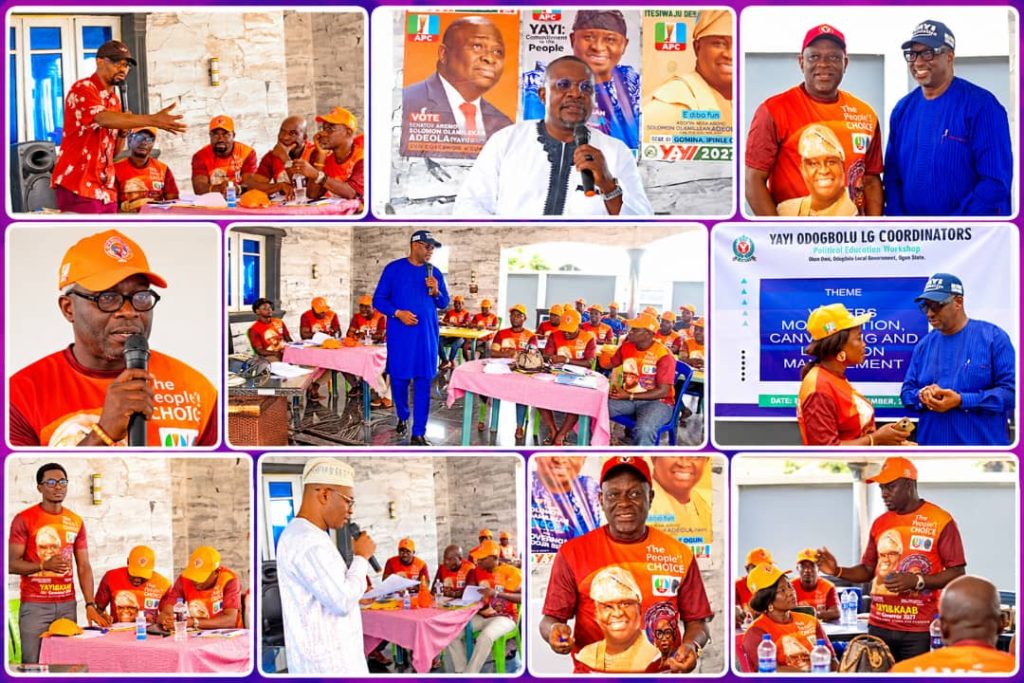
 In a strategic move to strengthen grassroots organisation, deepen political understanding and enhance electoral preparedness ahead of the 2027 general elections, the Yayi Odogbolu Local Government political structure has convened a comprehensive Political Education Workshop and Coordinators’ Strategic Meeting, bringing together key political stakeholders and coordinators for an intensive engagement on voter contact, canvassing, mobilisation and election management.
The workshop, held on Tuesday, 24th November, 2026, at the residence of the Local Government Coordinator, Hon. Ola Olufunmilayo, Okun-Owa, Odogbolu Local Government Area, Ogun State, provided a platform for political education, knowledge sharing and strategic discussions on the responsibilities of grassroots coordinators in building an organised and effective political structure ahead of the forthcoming elections.
With the theme, “Voters’ Contacting, Canvassing, Mobilisation and Election Management,” the meeting focused on equipping participants with the knowledge, practical skills and organisational understanding required to navigate the electoral process, strengthen community engagement, understand election results management and improve communication across the various levels of the political structure.
The programme, which commenced at 10:00 a.m., was moderated by Hon. Ola Olufunmilayo, Yayi Coordinator, Odogbolu Local Government, alongside Aremo Tunde Adesanya, Esq., Assistant Coordinator.
 In his opening remarks, Hon. Ola Olufunmilayo welcomed participants and emphasised the importance of political education as a critical instrument for building a disciplined, knowledgeable and well-coordinated grassroots structure. He stressed that the success of any political organisation depends largely on the commitment, preparedness and effectiveness of its coordinators, urging participants to take their respective responsibilities seriously and work collectively towards achieving the organisation’s objectives ahead of the 2027 general elections.
The first technical session was delivered by Giwa (Hon.) Adebowale Ojuri, former Member of the Ogun State House of Assembly, who examined the intricacies of election results management, the relevance of INEC result forms and the importance of effective political communication in voters’ mobilisation.
His presentation provided participants with an understanding of the electoral results management process, particularly the movement of election results from the Polling Unit through the Ward, Local Government and State collation centres, culminating in the appropriate declaration of results.
He explained the functions of the various INEC result forms, including EC8A, which captures results at the Polling Unit; EC8B, used for Ward or Registration Area collation; EC8C, for Local Government Area collation; EC8D, for State-level collation; and EC8E, relating to the final declaration of results, as applicable.
Hon. Ojuri identified the Polling Unit as the foundation of the electoral results management process, explaining the procedures that follow the conclusion of voting, including the sorting and counting of ballot papers in public, the recording of results by the Presiding Officer and the completion, signing and stamping of Form EC8A. He also discussed the display of results at the Polling Unit through the prescribed EC60E poster and the electronic transmission of result sheets through the Bimodal Voter Accreditation System (BVAS) to INEC’s Result Viewing Portal (IReV).
Moving through the different stages of collation, the former lawmaker explained how results are aggregated at the Ward and Local Government levels before proceeding to the appropriate State or National Collation Centres. He emphasised that accuracy, transparency and proper documentation at every stage are essential to maintaining the integrity of the electoral process.
 Particular attention was given to the importance of Form EC8A, which he described as the primary documentary record of results at the Polling Unit. According to him, the form provides essential information on accredited voters, valid votes, rejected votes and the scores recorded by political parties and candidates. He noted that its proper completion, authentication and preservation are important for verification, transparency and the resolution of possible electoral disputes.
The presentation generated considerable interest during the interactive session, as participants sought clarification on how the integrity of Polling Unit results could be protected against possible discrepancies during subsequent collation. In response, Hon. Ojuri emphasised the importance of vigilance, proper documentation and adherence to established electoral procedures. He advised that authorised party agents should remain present during counting, ensure that result sheets are properly completed and signed, preserve available copies and promptly report any discrepancies through the appropriate channels.
He further underscored the need for effective communication between Polling Unit agents, Ward coordinators and Local Government leadership to ensure that relevant information is properly documented and escalated.
The second major presentation was delivered by Professor Gafar Idowu Abolaji of the Department of Political Science, Tai Solarin Federal University of Education (TASFUED), Ijagun, Ogun State. His presentation, which focused on the theoretical and practical dimensions of voters’ contacting, canvassing and mobilisation, offered participants a deeper understanding of voter behaviour, political communication and the dynamics of grassroots engagement.
Professor Abolaji opened his presentation with an explanation of the concept of politics, describing it as “Who gets what, when and how.” He proceeded to examine three political theories that provide useful perspectives on voter behaviour and political participation: Party Identification Theory associated with Campbell, Rational Choice Theory associated with Anthony Downs and the Two-Step Flow Theory of 1948.
Explaining Party Identification Theory, he noted that individuals often develop lasting political affiliations through socialisation and interactions within their families, religious institutions, community associations and other social structures. On Rational Choice Theory, he explained that voters may consider the perceived costs and benefits of participating in elections, including transportation expenses, time and other inconveniences. He also discussed the Two-Step Flow Theory, which explains how information and public opinion can spread through influential individuals and opinion leaders within communities.
The professor stressed that understanding these theories provides useful insight into how individuals form political opinions, make electoral choices and respond to different forms of communication.
He subsequently examined the distinctions between voters’ contacting, canvassing and mobilisation, describing them as interconnected but distinct aspects of grassroots political engagement. Voters’ contacting, he explained, involves direct and indirect communication with individuals, ranging from personal conversations, telephone calls and door-to-door visits to the use of radio, television, social media, flyers and other communication channels.
He emphasised the importance of meaningful interaction, active listening and consistent follow-up, introducing the Rule of Three Contacts as a framework for sustaining engagement and building relationships.
On canvassing, Professor Abolaji explained that effective engagement requires an understanding of people’s concerns, expectations and political dispositions. He stressed the importance of courtesy, patience, emotional intelligence and clear communication, noting that interactions should be guided by mutual respect, irrespective of individual political preferences.
He further explained that mobilisation goes beyond communication and canvassing, involving the broader process of encouraging eligible citizens to participate in elections and exercise their civic rights.
One of the major highlights of his presentation was his identification of five important pillars of grassroots mobilisation, comprising traditional institutions, economic authorities, transport authorities, religious leaders and youth authorities. He identified Obas, Baales and Olorituns as important traditional institutions; Iyalojas, Babalojas, market leaders and traders’ associations as economic structures; Okada unions and commercial motor vehicle associations as transport networks; CAN representatives, Imams and Alfas as religious stakeholders; and youth leaders, grassroots volunteers and social media voices as important youth structures.
He explained that these community institutions play significant roles in social organisation, communication and civic participation, making it important to understand their place within the broader grassroots environment.
The presentation also examined voter segmentation, identifying three broad categories: APC loyalists, swing and undecided voters, and opposition loyalists. Professor Abolaji stressed the importance of maturity, civility and respect for individual political choices in all forms of community engagement.
Another significant aspect of the presentation was the introduction of the 10-10-10 Mobilisation Index, an organisational framework designed to establish defined responsibilities at the grassroots level. Under the proposed structure, each coordinator is expected to develop a network comprising 10 canvassers, 10 compound or household heads and 10 committed voters under each compound or household head.
The professor explained that the framework was intended to encourage structured community-level engagement, improve coordination and establish measurable responsibilities within the grassroots organisation.
He also addressed election-day preparedness, highlighting the importance of proper coordination, communication with authorised party agents, observation of electoral procedures and accurate documentation of results. He strongly emphasised the need for peaceful political participation, respect for electoral laws and rejection of electoral violence.
A particularly striking statement from his presentation was, “Odogbolu will be won in Odogbolu, not Abeokuta,” a remark that underscored the importance of local responsibility, grassroots organisation and effective coordination within the local government.
To ensure that the knowledge acquired during the workshop translates into practical activities, Professor Abolaji assigned specific tasks to the coordinators. Each coordinator is expected to prepare a Ward Voters’ Map indicating the Polling Units, registered voters and APC votes recorded during the 2023 general elections. They are also required to compile a list of 50 individuals contacted, including their names and telephone numbers, as well as a separate list of 10 canvassers, with appropriate consent and responsible handling of personal information.
He concluded his presentation by describing canvassers as “Grassroots Democratic Builders,” highlighting their importance in connecting political structures with the electorate.
The workshop also received an address from Hon. Olalekan Lukman Adeleye, Member of the Ogun State House of Assembly, representing Odogbolu State Constituency, who charged participants to place unity, cooperation and collective responsibility at the centre of their activities.
Hon. Adeleye emphasised the importance of harmonious working relationships among the Local Government Coordinator, Assistant Coordinators and other stakeholders, noting that a united and inclusive structure is essential for effective grassroots organisation. He encouraged participants to remain committed, focused and diligent in carrying out their assignments, stressing that no stakeholder should be left behind in the overall process.
Further insights into organisational accountability and communication were provided by Hon. Obafemi Onakoya, Assistant Coordinator, Odogbolu Local Government, who delivered a presentation titled “Our Focus, Goal and Objectives: Reporting and Escalation.”
His presentation focused on the importance of structured reporting, accurate documentation and timely communication within the political coordination framework. He explained that effective administration requires coordinators to provide clear, factual and properly organised reports from their respective areas of responsibility.
Hon. Onakoya outlined seven essential components of an effective report: a clear heading, date and time, identification of the actors involved, a factual account of events, solutions, recommendations and a conclusion. He also guided participants on the appropriate reporting channels and the procedures for submitting reports to the Local Government Coordinator responsible for their respective zones.
He stressed that effective reporting and escalation are indispensable to accountability, informed decision-making and efficient coordination, urging participants to ensure that relevant information is communicated promptly and accurately.
The closing remarks and vote of thanks were delivered by Hon. Deji Kalejaiye, who appreciated the resource persons, political leaders and participants for their contributions and active involvement throughout the workshop.
In his remarks, Hon. Kalejaiye drew attention to the voter apathy recorded during the 2023 gubernatorial election, stating that over 80 per cent of registered voters stayed away from the polls. He consequently emphasised the need for sustained voter awareness, civic education and community engagement to encourage greater participation in the electoral process.
He urged coordinators to intensify their engagements, strengthen their respective structures and ensure effective communication across the Wards and Polling Units of Odogbolu Local Government.
The strategic meeting also reaffirmed the political structure’s stated objectives ahead of the 2027 general elections, with discussions covering the presidential, governorship, senatorial, House of Representatives and House of Assembly contests. The positions identified included the APC Presidential Candidate; Distinguished Senator Solomon Olamilekan Adeola (Yayi) for the governorship position; the APC Senatorial Candidate for Ogun East Senatorial District; the APC Candidate for Ijebu Central Federal Constituency; and the APC Candidate for Odogbolu State Constituency.
The discussions emphasised the importance of building a coordinated organisational framework across the five elective positions, with clearly defined responsibilities for the Local Government Coordinator, Assistant Coordinators, Ward Coordinators and other stakeholders.
Overall, the workshop provided a valuable platform for capacity development, strategic reflection and organisational strengthening. Beyond the technical presentations, it reinforced the importance of political education, effective leadership, accurate documentation, responsible communication and unity in building a functional grassroots structure.
The practical assignments issued to coordinators are expected to provide a foundation for translating the knowledge acquired into structured activities across the Wards and Polling Units, while the emphasis on reporting and escalation is expected to strengthen accountability and information flow within the organisation.
The meeting concluded with a renewed call for commitment, discipline, cooperation and preparedness among all stakeholders, as the Yayi Odogbolu Local Government political structure continues its organisational activities towards the 2027 general elections.
He encouraged coordinators to maintain proper reporting channels and ensure that relevant information is communicated promptly to the appropriate leadership.
Delivering the closing remarks and vote of thanks, Hon. Deji Kalejaiye appreciated the resource persons and participants for their contributions and active involvement throughout the workshop.
He particularly challenged coordinators to intensify voter engagement, especially among citizens who did not participate in previous elections.
Referring to the high level of voter apathy recorded during the 2023 governorship election, he stated that over 80 per cent of registered voters stayed away from the polls, stressing the need for more deliberate efforts to improve participation through sustained community engagement and voter education.
He charged coordinators to double their efforts, strengthen their respective grassroots structures and ensure that eligible voters are encouraged to participate in the democratic process.
BUILDING A UNIFIED STRUCTURE FOR 2027
The workshop reinforced several strategic priorities, including Polling Unit-based organisation, voter mapping, continuous community engagement, electoral education, effective reporting, grassroots coordination and peaceful democratic participation.
A major objective remains the development of a united and result-oriented political structure capable of delivering victory for all APC candidates in the 2027 general elections across Odogbolu Local Government.
The political structure is working towards supporting the APC candidates for the Presidency, Governorship, Ogun East Senatorial District, Ijebu Central Federal Constituency and Odogbolu State Constituency.
The emphasis, therefore, is on building a coordinated structure that recognises the importance of every elective position and ensures that grassroots mobilisation is not concentrated around only one candidate.
The entire programme was moderated by Aremo Tunde Adesanya, Esq., whose coordination provided structure and direction to the proceedings.
CONCLUSION
The Yayi Odogbolu Political Education Workshop represents an important step towards strengthening grassroots capacity and preparing political coordinators for the organisational demands of the 2027 general elections.
Beyond the presentations and theoretical discussions, the workshop provided practical tools, assignments and strategic direction to help coordinators translate political education into measurable grassroots activities.
The central message was unmistakable: effective political organisation requires preparation, discipline, unity, continuous engagement and accountability at every level.
As the countdown to 2027 continues, the responsibility rests on every coordinator, Ward structure and grassroots stakeholder to contribute meaningfully to building a formidable and well-organised political network across Odogbolu.
The ultimate objective remains a united political structure working collectively towards the success of all APC candidates in the 2027 elections.