
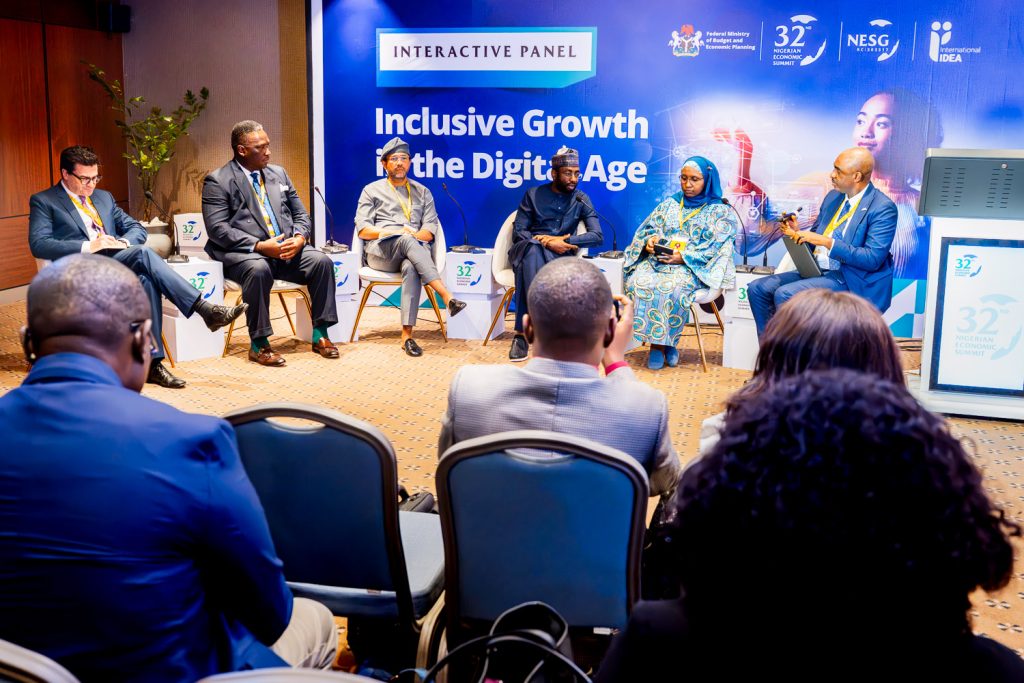
 The Director-General of the National Information Technology Development Agency (NITDA), Kashifu Inuwa, has underscored the importance of inclusive digital infrastructure, affordable connectivity and sustained investment in emerging technologies as critical drivers of Nigeria’s economic growth and national development.
Inuwa made this known during a session titled “Inclusive Growth in the Digital Age” at the 32nd Nigerian Economic Summit (NES#32), organised by the Federal Ministry of Budget and Economic Planning.
He stressed that expanding telecommunications infrastructure, particularly to underserved and rural communities, was essential to bridging the digital divide, stimulating economic activities and ensuring that more Nigerians benefit from the opportunities offered by the digital economy.
Reflecting on the evolution of Nigeria’s telecommunications sector since 2000, the NITDA boss recalled that early investors were initially sceptical about the viability of the African market, particularly regarding consumers’ ability to afford mobile communication services.
However, through innovative business models, infrastructure development and strategic investments, the sector overcame significant challenges, including inadequate electricity supply, poor road networks and limited supporting infrastructure.
He noted that Nigeria must sustain this spirit of innovation by democratising access to digital services, reducing connectivity costs and extending broadband infrastructure to communities that remain underserved.
According to him, connectivity has become a fundamental requirement for economic and social inclusion, especially as artificial intelligence continues to influence global decision-making, business operations and public service delivery.
Inuwa warned that communities without adequate digital representation risk being excluded from the benefits of emerging technologies, including artificial intelligence.
“If you are not represented, if you are not digitally visible, AI will not see you or consider you when making decisions,” he stated, emphasising the importance of ensuring that Nigeria’s cultures, values and languages are adequately represented in the evolving digital ecosystem.
He highlighted the Federal Government’s commitment, under President Bola Ahmed Tinubu, to leveraging technology for inclusive growth, noting that the President had directed the Minister of Communications, Innovation and Digital Economy, Dr Bosun Tijani, to drive two major connectivity initiatives: the Universal Service Provision Fund (USPF) project and Project BRIDGE.
According to Inuwa, the USPF initiative is designed to extend telecommunications coverage to underserved communities through the deployment of base stations, while Project BRIDGE aims to deliver approximately 95,000 kilometres of fibre-optic infrastructure across the country.
He explained that both initiatives would promote open-access infrastructure, encourage private-sector investment and improve broadband affordability and accessibility for individuals and businesses.
The NITDA Director-General further called for a broader approach to national infrastructure development, arguing that Nigeria’s economic priorities must now include investments in digital infrastructure alongside traditional assets such as roads, bridges and railways.
“Today, we are in a digital era; therefore, we need to build digital highways for our data as well,” he said.
He added that as Nigeria strengthens its artificial intelligence ambitions, investments in data centres, computing capacity and AI factories would be necessary to build the technological foundation required to harness the economic opportunities of AI.
Addressing the relationship between connectivity, productivity and affordability, Inuwa described it as an interconnected challenge, explaining that while telecommunications operators consider consumers’ purchasing power when investing in network expansion, improved connectivity can equally stimulate productivity, create new business opportunities and increase household incomes.
He maintained that connecting rural and underserved communities would enable individuals and businesses to access wider markets, improve their livelihoods and participate more actively in economic activities.
Beyond its commercial benefits, he noted that inclusive digital infrastructure would also transform public service delivery by enabling citizens to access government services more efficiently while reducing administrative costs.
He explained that from birth registration and healthcare to education, employment, business registration and property ownership, citizens interact with government institutions at different stages of their lives. Digital infrastructure, he said, would make it possible to access many of these services remotely, reducing the need for multiple physical visits to government offices.
Inuwa reiterated that achieving inclusive growth in the digital age requires stronger collaboration between government and the private sector, sustained investment in connectivity and deliberate policies that ensure no community is left behind.
He said expanding digital infrastructure would not only accelerate Nigeria’s digital transformation but also strengthen productivity, create economic opportunities and position more Nigerians to contribute meaningfully to the country’s emerging digital economy.