
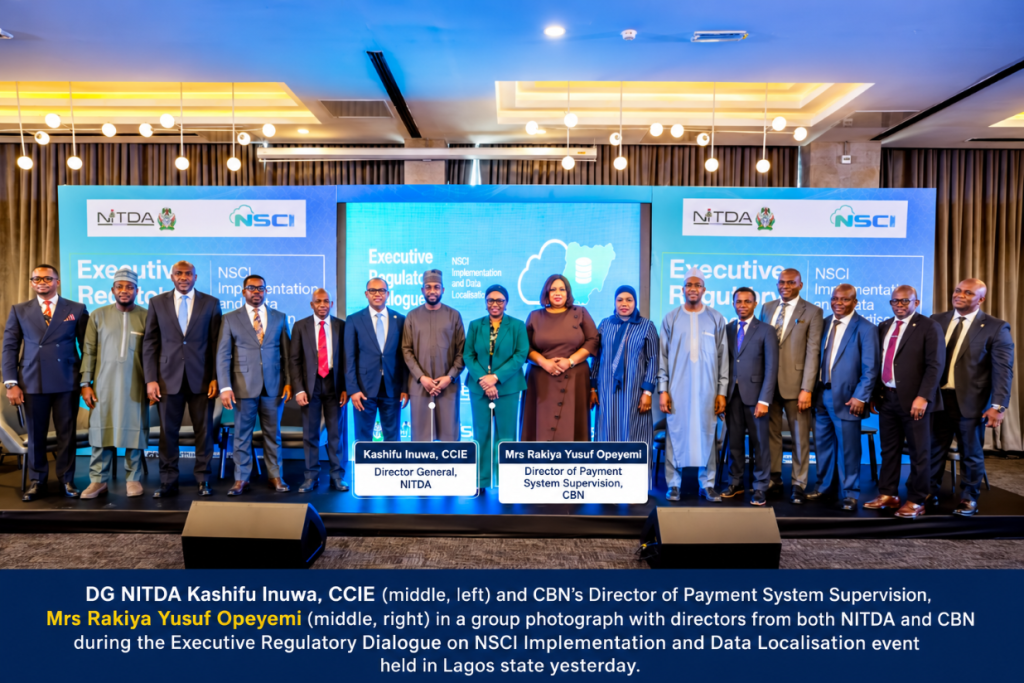
 The National Information Technology Development Agency (NITDA) and the Central Bank of Nigeria (CBN) have strengthened their collaboration towards advancing Nigeria’s digital sovereignty through the implementation of the National Sovereign Cloud Initiative (NSCI) and data localisation, with particular focus on the country’s financial services sector.
The partnership was reinforced at an Executive Regulatory Dialogue organised by NITDA in collaboration with the CBN in Lekki, Lagos State. The engagement brought together stakeholders from the financial services, telecommunications, data centre and technology sectors to deliberate on strategies for strengthening local digital infrastructure, securing critical national data and reducing the country’s dependence on externally hosted digital systems.
Speaking at the event, the Director General of NITDA, Kashifu Inuwa, described digital sovereignty as an important national priority, particularly as Nigeria’s economy becomes increasingly dependent on digital platforms and infrastructure for the delivery of essential services.
He warned that disruptions arising from geopolitical tensions, external infrastructure failures or restrictions on access to foreign-hosted technology could pose significant risks to the country’s financial system and economic stability.
According to him, digital sovereignty goes beyond data storage or technological independence; it involves developing the capacity to make informed decisions about the technologies, infrastructure and standards that support Nigeria’s digital economy.
Inuwa clarified that the initiative was not designed to isolate Nigeria from global technological developments or compel the country to develop every technology locally. Rather, it seeks to build the capacity to compete globally while maintaining control over critical digital infrastructure and national interests.
He cited Nigeria’s cashless policy as an example of how deliberate regulatory interventions could stimulate local innovation, explaining that the CBN’s earlier push for financial institutions to upgrade their technology infrastructure helped create opportunities for fintech companies and contributed to the growth of Nigeria’s digital financial ecosystem.

The NITDA boss expressed confidence that the financial sector could once again lead Nigeria’s digital transformation through the implementation of the National Sovereign Cloud Initiative.
He noted that NITDA and the CBN were working to position the financial services sector as the first to align with the initiative, adding that the Agency would provide the necessary policy direction, standards and assurance framework to guide implementation across sectors.
Inuwa identified control, independence, resilience, risk management and freedom of choice as the fundamental principles underpinning digital sovereignty. He stressed the need for infrastructure capable of sustaining critical financial operations even when external systems or international connectivity routes experience disruptions.
He also emphasised the importance of avoiding excessive dependence on individual technology vendors or foreign jurisdictions, noting that Nigeria must retain the flexibility to determine the infrastructure and technology solutions that serve its national interests.
In his keynote address, the Deputy Governor, Financial System Stability, CBN, Mr Lamido Abubakar Yuguda, reaffirmed the Bank’s commitment to strengthening financial stability, cybersecurity and the protection of critical financial data through the initiative.
Yuguda noted that the rapid expansion of digital payments, mobile money, fintech services and digital banking had significantly increased the financial sector’s reliance on digital infrastructure, making data protection, business continuity and disaster recovery essential priorities.
He called on financial institutions to strengthen their cybersecurity and risk management frameworks while ensuring compliance with data localisation requirements, particularly ahead of the January 1, 2027 implementation timeline for critical payment transaction data.
The CBN Deputy Governor stressed that the initiative should create an enabling environment for innovation rather than isolate Nigeria from global technology opportunities.
“Our collective objective should be clear: to build a digital financial ecosystem that is innovative without compromising security, sovereign without becoming isolated and resilient enough to sustain public confidence,” he stated.
Further insights into the readiness of Nigeria’s digital infrastructure ecosystem were presented by the Special Assistant to the NITDA DG on Policy, Dr Muhammad Aminu Lawal, who shared findings from a pre-event survey conducted among industry stakeholders.
According to Lawal, the survey identified regulatory clarity, migration timelines and local infrastructure capacity as critical issues requiring attention ahead of the January 2027 implementation deadline.
He disclosed that the findings showed encouraging readiness among local digital infrastructure providers, with 79 per cent of the 42 providers surveyed indicating their capacity to accommodate additional financial-sector workloads, while 74 per cent said they could onboard new financial services customers within three months.
However, he noted that significant infrastructure expansion was anticipated in 2027, with financing costs, electricity supply and foreign exchange challenges identified as major constraints.
The survey consequently recommended clear regulatory guidelines, phased and risk-based implementation milestones, a defined exceptions framework and verifiable information on certified local infrastructure providers.
Lawal stressed that coordinated engagement among NITDA, the CBN and industry stakeholders would be essential to resolving implementation uncertainties, strengthening local infrastructure capacity and ensuring a smooth transition towards Nigeria-based data hosting and management.
The collaboration underscores the growing importance of digital sovereignty in Nigeria’s economic development, particularly as the country seeks to strengthen data security, improve the resilience of critical infrastructure and build a sustainable digital ecosystem capable of supporting its financial system and wider economy.