
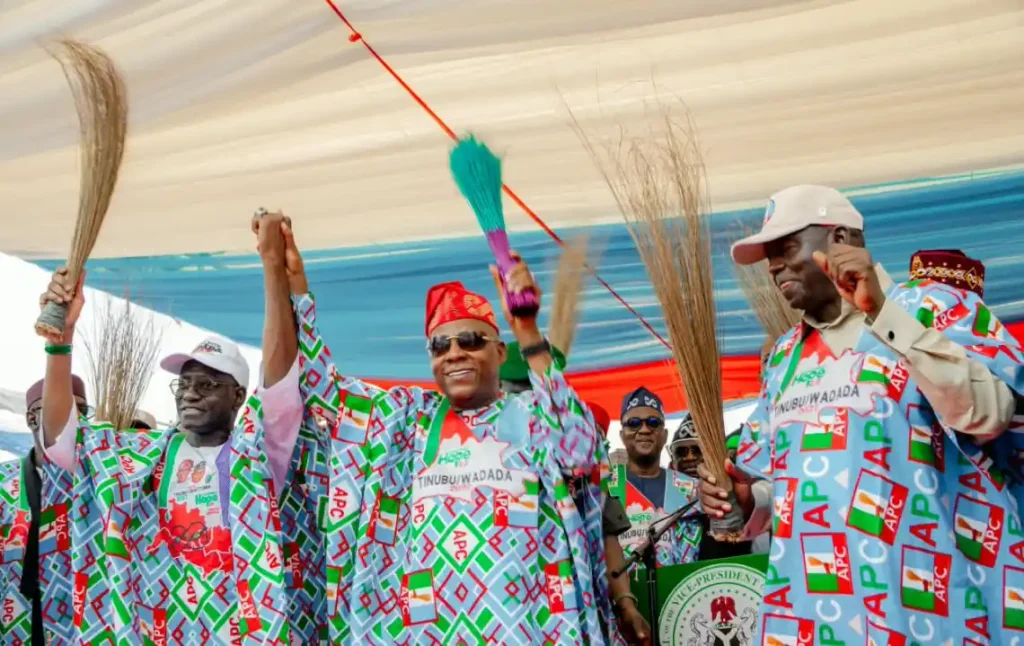
The National Chairman of the All Progressives Congress (APC), Professor Nentawe Goshwe Yilwatda, has issued a forceful endorsement of President Bola Ahmed Tinubu and Vice President Kashim Shettima ahead of the 2027 general elections, characterizing their partnership as one of the most formidable political alliances in Nigeria’s democratic history.
Addressing thousands of party loyalists, political power brokers, and regional delegates on Saturday at the Rainbow Coalition Presidential Campaign Rally held at the Adokiye Amiesimaka Stadium in Port Harcourt, Rivers State, Yilwatda contended that the incumbent administration merits a second four-year mandate to institutionalize its sweeping macroeconomic reforms and bring its flagship infrastructure initiatives to full fruition.
The Port Harcourt gathering, which drew stakeholders from across Rivers State and the wider oil-rich South-South geopolitical zone, forms a pivotal leg of the ruling party’s early nationwide mobilization campaign ahead of the 2027 polls. Beyond serving as a demonstration of numerical strength, the rally underscored an evolving political realignment in a state historically defined by fierce partisan rivalries, signaling a coordinated push by the APC and its allied coalition partners to consolidate regional support well ahead of the election cycle.
In his keynote remarks—and in an accompanying press statement issued through his Special Adviser on Media and Information Strategy, Abimbola Tooki—Yilwatda framed the Tinubu-Shettima ticket as a rare synthesis of political acumen, administrative capacity, and executive resolve. According to the party chairman, those attributes are indispensable for steering Nigeria past decades-long structural bottlenecks toward sustainable economic expansion and national prosperity.
“The most formidable presidential ticket we have ever produced in Nigeria is the Tinubu-Shettima ticket,” Yilwatda told the stadium crowd. “We have a candidate in President Bola Ahmed Tinubu who is fearless, courageous, and determined to confront the challenges of our country. He has demonstrated the capacity to take difficult decisions in the national interest, and he has remained resolute in pursuing the transformation of Nigeria.”
Central to Yilwatda’s argument for continuity is the administration’s handling of the fiscal crisis it inherited upon taking office. For years, economists and multilateral institutions had warned that Nigeria’s public finances were being hollowed out by unsustainable fuel subsidy expenditures, chronic revenue shortfalls, and escalating debt-service obligations. Rather than deferring those politically sensitive choices, Yilwatda noted, President Tinubu opted for immediate structural intervention.
Specifically, the APC chairman pointed to two cornerstone policy shifts: the termination of the decades-old petrol subsidy regime and the unification of the country’s multiple foreign exchange windows. While both measures triggered immediate inflationary pressures, currency volatility, and painful adjustments across Nigerian households and commercial enterprises, Yilwatda maintained that they were unavoidable prerequisites for restoring fiscal solvency, curbing arbitrage, and establishing a transparent foundation for long-term growth.
Acknowledging the economic strain experienced by ordinary citizens and businesses during the transition, Yilwatda stressed that the federal government is pairing its macroeconomic tightening with targeted stabilization measures. These include expanded social interventions, capital infrastructure investments, and economic policies designed to stimulate domestic productivity and widen opportunities across both formal and informal sectors.
“President Tinubu has confronted enormous challenges since assuming office, and rather than surrendering to them, he has taken decisive steps to address the structural problems that have constrained our national development for decades,” Yilwatda stated. “He inherited a country facing serious fiscal and economic difficulties, including unsustainable fuel subsidy expenditure, revenue constraints, and mounting obligations. His administration has demonstrated the political will to confront these challenges through difficult but necessary reforms.”
Beyond fiscal and monetary restructuring, the APC National Chairman spotlighted the administration’s capital expenditure drive as a defining pillar of its Renewed Hope Agenda. Yilwatda argued that physical connectivity remains the primary enabler of domestic trade, industrial competitiveness, and national cohesion across Africa’s most populous nation.
He highlighted the federal government’s ongoing investments in strategic highway corridors and proposed superhighway networks designed to link disparate economic zones across the federation. By lowering haulage costs, cutting transit times, and opening up previously isolated agrarian and industrial hubs, these transport arteries are expected to catalyze growth across multiple sectors—from agro-processing and manufacturing to domestic tourism and cross-border commerce.
“We have a President who understands that development cannot happen without infrastructure,” Yilwatda said. “He has initiated an ambitious infrastructure revolution through major highway projects that will connect different parts of Nigeria, open up economic corridors, facilitate the movement of goods and services, and create new opportunities for our people.”
He added that the scope of these civil engineering undertakings extends well beyond immediate transport logistics: “These are not merely road projects. They are investments in the future of our country—in agriculture, commerce, industrialization, tourism, and the prosperity of future generations.”
Urging the electorate to maintain a long-term perspective on the Renewed Hope Agenda, Yilwatda cautioned against truncating the current policy cycle before its compounding benefits mature. He contrasted President Tinubu’s governance approach—which he characterized as that of a “reformer and performer” placing national development above political convenience—with short-term political expediency, asserting that the 2027 ballot will present voters with a clear choice between policy continuity, stability, and institutional disruption.
A central subtext of the Port Harcourt rally was the visible convergence of rival political blocs in Rivers State under the banner of the Rainbow Coalition. Historically a bastion of opposition politics during previous presidential election cycles, Rivers has increasingly become the focal point of intricate cross-party negotiations aimed at consolidating support for the presidency.
Yilwatda expressed satisfaction with the growing consensus among the state’s political elite, commending local leaders, community stakeholders, and coalition members for prioritizing national unity, political cooperation, and developmental continuity over rigid partisan boundaries. According to the APC chairman, the willingness of diverse political actors in Rivers to rally behind the president reflects a pragmatic recognition that the success of the Tinubu administration serves the collective interest of Nigerians, irrespective of party affiliation.
“Come 2027, we want to continue with this reformer and performer as our President,” Yilwatda declared to cheers from the stands. “That is why the coalition and the people of Rivers State, irrespective of political party, have decided to work together for President Bola Ahmed Tinubu.”
Political observers note that securing a unified front in Rivers State carries strategic weight far beyond the state’s borders. As the commercial and energy nerve center of the South-South geopolitical zone, Rivers frequently sets the political tone for neighboring states, making early coalition-building there a critical component of any nationwide campaign blueprint.
Projecting a 2027 Electoral Stronghold
Looking ahead to the formal commencement of the next election cycle, Yilwatda expressed robust confidence that Rivers State would transition into a decisive electoral stronghold for the Tinubu-Shettima ticket. He attributed this projection to the combined grassroots machinery of the state’s foremost political figures, explicitly citing the mobilization capacity of Rivers State Governor Sir Siminalayi Fubara alongside the Minister of the Federal Capital Territory and former Rivers governor, Chief Nyesom Wike.
In Nigerian political calculus, the alignment of both the sitting governor’s administrative structure and the FCT minister’s deeply entrenched statewide political network represents a formidable electoral force—one capable of delivering high voter turnout in a state that consistently ranks among the top contributors of presidential ballots in southern Nigeria. At the rally, Governor Fubara underscored that commitment by setting an ambitious target of three million votes from Rivers State for the 2027 presidential election.
“Come January 2027, Rivers State will stand still,” Yilwatda predicted. “With the mobilization capacity of the Governor of Rivers State, Sir Siminalayi Fubara, the Honourable Minister of the Federal Capital Territory, Chief Nyesom Wike, and other political leaders and stakeholders, we are confident that Rivers will deliver maximum votes for President Bola Ahmed Tinubu.”
Concluding his address on an aspirational note, the APC National Chairman reiterated that the ultimate benchmark of the administration’s second term would be measurable, broad-based prosperity felt across every geopolitical zone of the federation.
“We are looking forward to a situation where every part of this country will feel the impact of the prosperity that the consolidation of these reforms will bring,” Yilwatda said. “By the grace of God, we shall return after the election to give thanks for a renewed mandate and a brighter future for Nigeria.”