
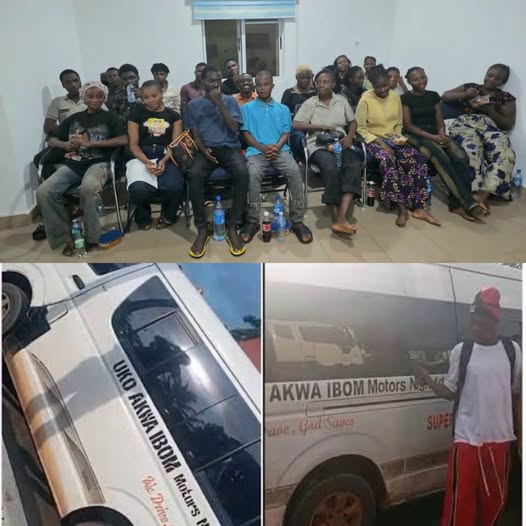
An Emotional Reunification at the DSS Headquarters The atmosphere at the Department of State Services (DSS) headquarters in Ibadan, the Oyo State capital, was charged with overwhelming emotion on Thursday. Relief, tears, and spontaneous prayers filled the air as 20 prospective National Youth Service Corps (NYSC) members returned home after enduring a harrowing seven-day ordeal in captivity. Their safe arrival in Ibadan followed a detailed debriefing and administrative engagement with DSS security officials that lasted over three hours. For the traumatized families who had spent an agonizing week fearing the worst, the return of their children brought an end to days filled with dread, sleeplessness, and relentless uncertainty.
Only designated representatives of the victims’ parents were granted access inside the DSS headquarters to reunite with their freed children, while many other well-wishers, neighbors, and extended family members waited anxiously outside the main gates. Tears flowed freely as the young graduates, visibly worn out from their terrifying ordeal in the forest, embraced their mothers and fathers. For seven grueling days, these prospective corps members had been held hostage in the dense forests of Imo State, their lives suspended in danger while their families fought frantically for their survival.
The Highway Ambush on the Owerri-Onitsha Expressway
The nightmare began a week earlier when two commercial vehicles carrying 30 prospective corps members from Oyo State were intercepted by heavily armed gunmen along the Owerri-Onitsha road in Umunoha, situated within the Mbaitoli Local Government Area of Imo State. The young graduates were traveling east to report at their designated NYSC orientation camps in Abia State, fulfilling their mandatory national youth service obligations.
During the chaotic ambush, ten alert prospective corps members managed to leap into the surrounding thickets and escape into the bush, eventually finding their way to safety and raising the alarm. However, twenty of their colleagues were rounded up at gunpoint and forced deep into the forest by the abduction gang. The traumatic incident underscored the persistent hazards that young Nigerian graduates face every year when commuting thousands of kilometers across regions plagued by highway robbery, banditry, and kidnap-for-ransom syndicates.
Voices of Relief: Parental Anguish and Urgent Calls for Reform
Among the relieved parents waiting at the DSS facility in Ibadan was Mrs. Faith Felicia Abiala, whose daughter was among the rescued victims. Speaking shortly after holding her daughter once again, Mrs. Abiala described her safe return as a moment of overwhelming relief, while emphasizing that the tragic incident had exposed the extreme dangers faced by young graduates traveling long distances by road to fulfill their national duty.
Refusing to remain silent about the systemic risks, Mrs. Abiala issued a direct call to the Federal Government and NYSC management to rethink transportation protocols for corps members:
“My advice to the government is that when corps members are posted to states for their service, the government should ensure proper security arrangements, or allow them to travel by air to avoid these kinds of dangerous road journeys.”
Her passionate appeal was echoed by other parents, including Alhaja Alimot Akande, who described the release as a major relief after days of excruciating agony. “It is good news! Good news! Good news!” Alhaja Akande exclaimed, noting that the confirmation of their freedom finally allowed exhausted families to sleep peacefully after a week of unbearable torture.
The Ransom Controversy: Contradictory Accounts of the Release
As news of the release spread, details emerged regarding the grueling negotiations that preceded the youths’ freedom. According to accounts provided by victims’ families, the abductors initially demanded an astronomical ransom of N50 million per victim, amounting to a staggering N1 billion total for the 20 captives. Following days of frantic appeals, the kidnappers eventually reduced their demand to N5 million per person, totaling N100 million.
Isiah Akpan, Managing Director of Uko Akwa Ibom Motors Nigeria Limited—the operating transport company—confirmed these financial demands. Several parents disclosed that they were forced to raise money frantically, taking out personal loans, pooling community contributions, and even securing foreign currency to pay ransom demands in U.S. dollars before the abductors agreed to let the graduates go. Some families reported contributing up to N6 million per child to secure their release.
Conversely, official law enforcement narratives presented a starkly different perspective. The Imo State Commissioner of Police, Audu Bosso, maintained that the kidnappers succumbed to intense tactical pressure from joint security agencies that had relentlessly combed the surrounding forest terrain during rescue operations. Commissioner Bosso stated that he was unaware of any ransom payments made by the families, attributing the release strictly to tactical security pressure.
High-Level Royal Interventions and Interstate Coordination
The eventual resolution of the crisis followed intense advocacy and high-level intervention involving traditional institutions and state leadership. Prior to the release, distressed parents had besieged the private residence of the Olubadan of Ibadanland, Oba Rashidi Ladoja, seeking his urgent intervention. The Oyo State Commissioner of Police, Olugbenga Abimbola, and the Aseyin of Iseyinland, Oba Sefiu Adeyeri, joined the Olubadan in mobilizing support and coordinating with security agencies in Imo State.
The official breakthrough was announced late Wednesday afternoon. In a formal statement issued by his media aide, Adeola Oloko, the Olubadan confirmed that the captives were finally safe:
The kidnapped graduates have been released. The Imo State Governor, Hope Uzodinma, confirmed this in a telephone conversation at about 5.00 pm.
While the safe reunion of the 20 prospective corps members in Ibadan brings immense joy and gratitude, it serves as a wake-up call for policy reform. The National Youth Service Corps scheme, established to foster national unity, cannot fulfill its purpose if young graduates are exposed to life-threatening risks on unsafe highways. Whether through mandatory armed security escorts, subsidized air transport, or localized postings, the government must take immediate, concrete steps to ensure that no Nigerian family ever endures seven days of terror again.