
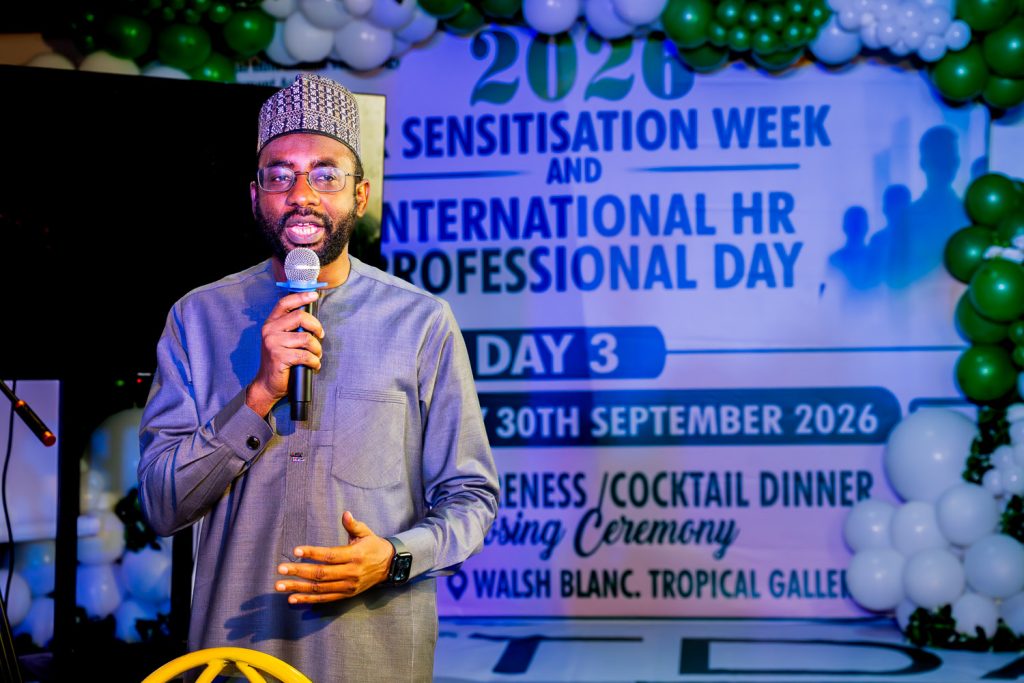
 The Director-General of the National Information Technology Development Agency (NITDA), Kashifu Inuwa, has inaugurated a Joint Management-Union Committee to create a structured platform for dialogue on staff welfare, capacity development, productivity and workplace conditions across the Agency.
The initiative was unveiled during the closing ceremony of NITDA’s Human Resources Sensitisation Week 2026, where the Director-General said the committee would provide a more effective and transparent mechanism for addressing staff concerns, rather than dealing with employee issues on an ad hoc basis.
According to Inuwa, bringing representatives of management and the staff union together would encourage greater consultation, improve communication and promote more inclusive decision-making on matters affecting employees.
He commended the Human Resources Department for organising the sensitisation programme but stressed that effective human resource management goes beyond enforcing policies and procedures, noting that the people remain central to NITDA’s ability to achieve its mandate.

The DG said the Agency must move from simply managing its workforce to deliberately unlocking the potential of its employees by creating an environment that encourages innovation, productivity and meaningful contributions.
“People are the operating system of the Agency. We want to unlock your potential. We want to make you innovative so that the Agency will achieve its mandate. So, as we continue to manage our personnel, it’s also important to start thinking of how we can move from managing people to unlocking their potential,” he said.
Inuwa explained that the Joint Management-Union Committee would have a broader mandate beyond training and capacity development, serving as a platform for addressing issues relating to staff welfare and workplace conditions. He subsequently declared the committee inaugurated and urged its members to commence work without delay.
The establishment of the committee followed concerns raised by employees regarding the allocation of training opportunities and other staff benefits. Responding to the concerns, the DG said opportunities for training and capacity development should increasingly take into consideration performance and contribution, rather than being determined solely by an employee’s rank.
Staff also raised concerns about the availability of working tools and the need for quicker intervention when employees experience medical emergencies or accidents.
In response, Inuwa said NITDA had continued to invest in digital tools and was working towards ensuring that employees had the equipment required to perform their duties effectively. He also highlighted the expansion of training opportunities within the Agency in recent years, including access to international programmes.
The Director-General described the engagement between management and employees as a “social contract”, stressing that while management has a responsibility to provide an enabling environment and prioritise staff welfare, employees must reciprocate with commitment, productivity, punctuality and effective service delivery.
He noted that improving staff welfare should go hand in hand with improved performance, adding that the Agency would benefit when employees are given the right conditions and opportunities to develop their capabilities and contribute fully to NITDA’s mandate.
The Joint Management-Union Committee comprises representatives of management, including the Director of Finance, Director of Human Resources, a representative of the Director-General and auditors, while the staff union is expected to nominate four representatives.
Earlier, the Director of Human Resource Management, Mr Sarafa Lawal, said the role of human resources had evolved beyond recruitment, personnel administration and welfare to become a strategic function in driving organisational performance, innovation and sustainability.
Lawal explained that contemporary human resource management must contribute to building organisational capacity and culture while ensuring that employees understand the Agency’s strategic direction, their responsibilities and the opportunities available for professional growth.
He described employees as strategic assets rather than merely costs to be managed, stressing that investments in training, professional development, coaching and career advancement should be regarded as investments in the long-term capacity of the institution.
The HR Director also emphasised that human capital development is a shared responsibility involving the Human Resources Department, directors, heads of departments and individual employees. While HR is responsible for providing the policies, systems, tools and support required for development, managers must provide leadership, coaching and constructive feedback, while employees must take ownership of their responsibilities and performance.
The three-day Human Resources Sensitisation Week combined professional development with activities aimed at promoting interaction, engagement and recognition among staff. The programme featured a football competition, a workshop for administrative staff on the new HR T-Model and an HR Clinic, which provided employees with an opportunity to engage directly on human resource-related issues.
The closing ceremony was attended by top management, heads of departments and unit heads, and featured recognition of staff for outstanding performance, attendance and punctuality. Best-dressed staff members were also rewarded, with cleaners, security personnel and other support staff included among those recognised.
The initiative reflects NITDA’s efforts to strengthen employee engagement while creating a more structured approach to addressing workplace concerns and developing the human capacity required to support the Agency’s mandate in Nigeria’s digital economy.