
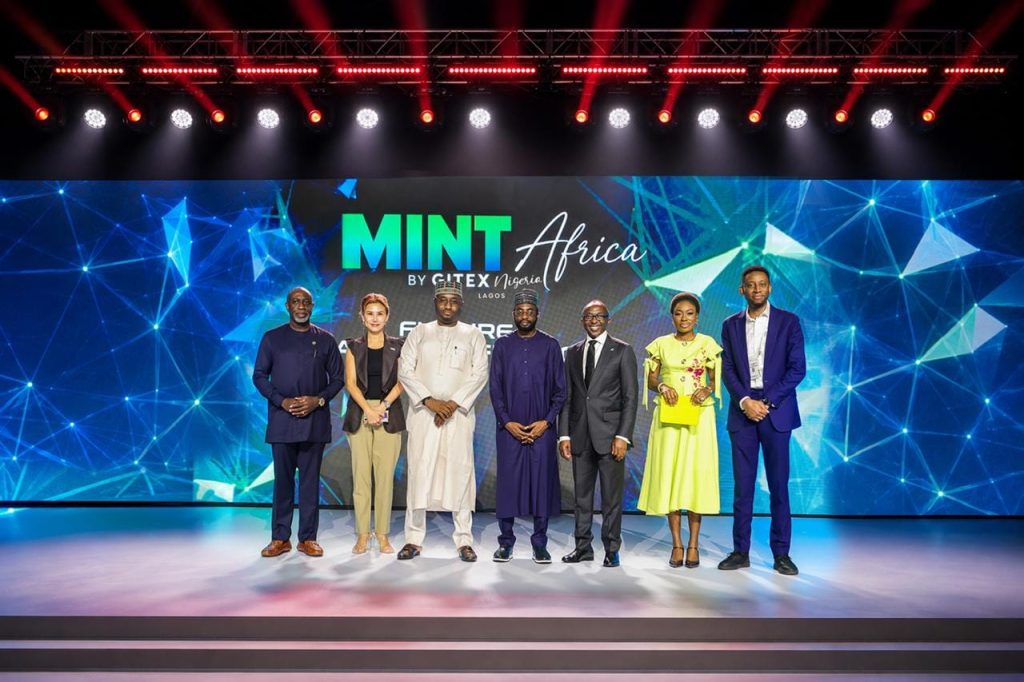
 GITEX NIGERIA has announced the launch of MINT AFRICA by GITEX, a new future-finance platform designed to bring together money, innovation, emerging technologies and transparency to accelerate the transformation of Africa’s financial economy.
The platform, which will debut during GITEX NIGERIA Week 2027 in Lagos, is set to convene governments, regulators, financial institutions, investors, fintech companies, technology firms and digital-asset innovators at a pivotal moment for the global financial system.
The launch positions Lagos at the centre of an increasingly technology-driven financial transformation, as artificial intelligence, tokenisation, stablecoins, digital identity, programmable money and next-generation payment infrastructure reshape how money moves, assets are owned and financial services are delivered.
Finance enters a new era
Across the world, the architecture of finance is rapidly changing. Money is becoming programmable, real-world assets are being tokenised, and agentic AI is beginning to transform financial services and decision-making.
At the same time, stablecoins and digital assets are challenging traditional financial rails, while digital identity, cybersecurity and interoperable payment systems are emerging as critical economic infrastructure.
For Africa, these developments present an opportunity to move beyond simply adopting new financial technologies and instead help shape the next generation of global finance.
Nigeria, with Africa’s largest fintech ecosystem, and Lagos, home to some of the continent’s most influential financial technology companies, are uniquely positioned to lead that transformation. The city combines market scale, entrepreneurial talent, growing investor interest and an increasingly ambitious digital economy.
Following the successful launch of GITEX NIGERIA, MINT AFRICA by GITEX 2027 will expand the technology exhibition’s mandate by creating a dedicated platform connecting capital, policy, regulation, infrastructure and frontier financial technologies across Africa.
In partnership with the Lagos State Government, the platform will leverage GITEX’s international network of technology companies, investors, governments and innovators to connect Africa’s financial ambitions with global capital and expertise.
H.E. Dr Kadri Obafemi Hamzat, Deputy Governor of Lagos State, said the arrival of GITEX in Nigeria reflected the commercial significance of Lagos.
“When GITEX came to Nigeria, Lagos became a commercial anchor. That was not a courtesy extended to us; it was a commercial judgement. Exhibitions follow markets, and markets follow scale, capital and momentum – all of which converge here.
“Lagos is a consequential destination and what happens here helps shape Africa’s digital transformation trajectory. The next chapter of African finance will not simply arrive; it will be built here, together.”
Tunbosun Alake, Honourable Commissioner for Innovation, Science, and Technology, Lagos State, said the new platform would help bridge the gap between financial innovation and investment.
“Africa doesn’t have a shortage of financial innovation. It has a shortage of the conversations that turn innovation into signed deals. The future of finance week is built to close that gap — not to celebrate it,” he said.
From financial inclusion to financial reinvention
Africa’s financial transformation is being driven by both technology and a growing demand for broader access to capital and financial services.
Africa’s digital payments economy is projected to reach US$1.5 trillion by 2030, while the African Development Bank estimates that reforms involving deeper capital markets, stronger domestic resource mobilisation and public-private partnerships could unlock as much as US$1.43 trillion in financing annually.
Yet significant gaps remain.
In Nigeria, adult account ownership increased from 45.3 per cent in 2021 to 63.3 per cent in 2024. However, only 9.1 per cent of adults borrowed through formal financial channels, highlighting the continuing gap between financial access and access to productive capital.
MINT AFRICA by GITEX will explore how emerging technologies and innovative regulatory frameworks can help close that gap by widening access to capital, modernising financial infrastructure and enabling more African consumers and businesses to participate in the digital economy.
Its agenda will cover tokenisation and real-world assets, agentic AI and intelligent banking, stablecoins and digital currencies, next-generation payments, digital identity, cybersecurity and trust, financial infrastructure, cross-border interoperability, regulatory innovation, capital markets and investment in Africa’s fintech economy.
Dr Nurudeen Abubakar Zauro, Technical Adviser to the President on Economic and Financial Inclusion, Nigeria, said deeper financial inclusion would be critical to achieving the country’s economic ambitions.
“The target of achieving a US$1 trillion economy means investment, financial sector deepening, formalisation of the informal sector and enhancing economic inclusion so that the benefits can reach the last mile. It also means bringing more people into the formal financial sector and supporting our ambitious MSMEs with the financing they need to scale,” he said.
Building the infrastructure for Africa’s financial future
As financial technology advances, experts say technology alone will not determine which markets emerge as leaders. Infrastructure, regulation, trust and investor confidence will be equally important.
Engr. Ganiyu Oseni, Special Adviser on Technology, Broadband and Innovation to the Governor of Lagos State, said infrastructure must remain central to the digital economy.
“Infrastructure is policy. You cannot simply regulate an economy into existence. For a digital economy, the roads are connectivity, power, identity and talent. Lagos has spent seven years building all four,” he said.
He also issued a direct invitation to international investors, saying: “Lagos is asking you to price us correctly. We would rather have your capital than your admiration, and we would rather have your operational presence than your capital.”
He added that Africa’s financial future would be “tokenised, programmable and cross-border,” arguing that Lagos was well positioned to become a major settlement point for the continent’s emerging digital financial economy.
The transformation will also require new approaches to ownership and investment.
Dr Armstrong Ume Takang, CEO of the Ministry of Finance Incorporated (MOFI), Nigeria, challenged African stakeholders to play a more active role in the emerging digital-asset economy.
“As we create digital tools that allow us to tokenise assets and make those assets widely available to investors, are Nigerians going to continue taking a back seat while others see the value, invest and benefit from the upside? Or are we going to become active participants in the evolving digital asset ecosystem?” he asked.
With digital assets operating across national borders, regulatory cooperation will also be critical.
Tahiru Al Hassan, Head of Oversight and Compliance, Virtual Assets Department, Bank of Ghana, stressed the need for stronger coordination across African markets.
“Greater regulatory coordination across Africa will be essential to addressing the inherently cross-border nature of digital assets, avoiding unnecessary fragmentation and building trusted, interoperable ecosystems across the continent,” he said.
Why Lagos. Why GITEX. Why now.
The decision to launch MINT AFRICA by GITEX alongside GITEX NIGERIA reflects the growing convergence between technology and finance.
Artificial intelligence is becoming part of financial infrastructure. Tokenisation is connecting technology with capital markets. Digital identity is linking citizens to financial services, while regulation is increasingly having to evolve alongside innovation.
At the same time, investment will determine which African markets successfully move from experimentation to scale.
Through GITEX’s global network of technology companies, investors, governments and innovators, MINT AFRICA by GITEX aims to bring these forces together on one platform, with Lagos serving as its marketplace and Africa as its mandate.
Trixie LohMirmand, CEO of GITEX, said Nigeria’s fintech leadership made Lagos a natural home for the new platform.
“Nigeria leads Africa’s fintech revolution. Its scale, talent and ambition make Lagos the deserving metropolis for MINT AFRICA by GITEX.
“But the next chapter goes far beyond fintech. AI is becoming agentic, assets are becoming tokenised, money programmable and financial markets increasingly borderless. Africa has an opportunity not merely to participate in this transition, but to shape it.
“Lagos is already home to the innovators redefining how money moves across this continent. With MINT AFRICA by GITEX at GITEX NIGERIA, our ambition is to bring together the technology, regulation, infrastructure and global capital required to turn that innovation into Africa’s next financial economy.”
MINT AFRICA by GITEX 2027 will take place in Lagos during GITEX NIGERIA Week 2027, bringing together the financial, technology, government and investment communities to explore the forces shaping Africa’s next financial era.
For more information, news and updates on GITEX NIGERIA, visit www.gitexnigeria.ng.