
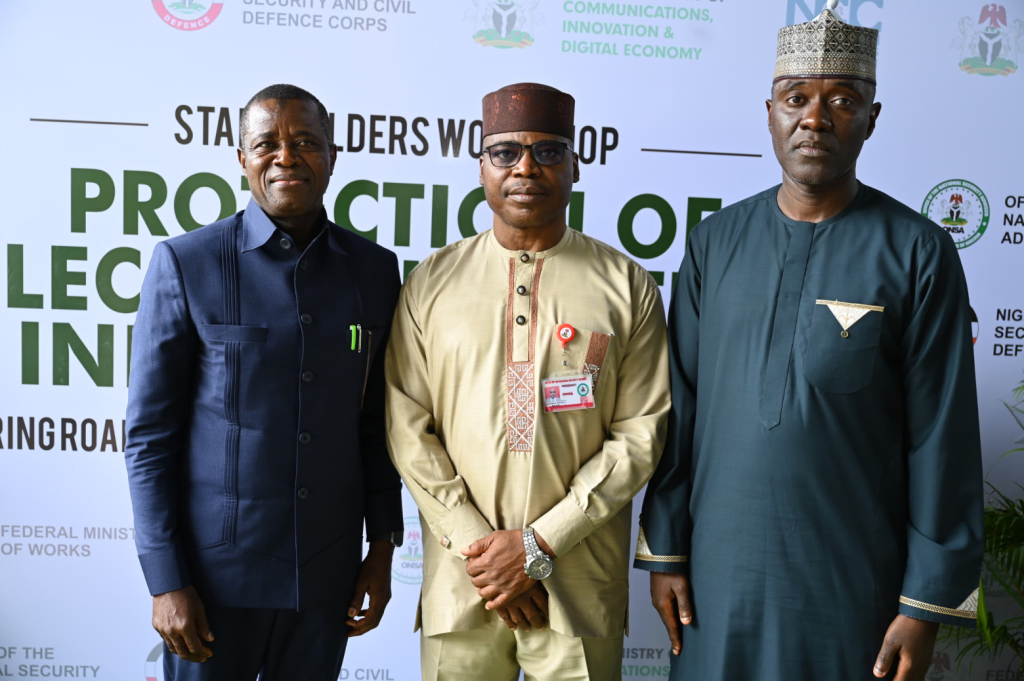
The Nigerian Communications Commission (NCC) has called for stronger collaboration among road construction companies, contractors, engineers, government agencies and telecommunications operators to prevent damage to fibre-optic cables during road construction, rehabilitation, excavation and other civil works across the country.
The Executive Vice Chairman and Chief Executive Officer of the NCC, Dr. Aminu Maida, made the call on August 11, 2026, at a stakeholders’ workshop on the protection of fibre-optic cables held at the National Counter-Terrorism Centre (NCTC), Office of the National Security Adviser, Abuja.
Maida stressed that Nigeria’s rapid development of physical infrastructure must go hand in hand with the protection of the digital infrastructure that connects citizens to essential services, businesses, markets and opportunities.
According to him, telecommunications infrastructure has become a critical national lifeline, supporting banking, government services, education, healthcare, commerce, security and emergency communications. Damage to fibre networks, he noted, can therefore have serious consequences for citizens, businesses and the wider economy.
The NCC boss disclosed that more than 5,000 fibre-cut incidents were recorded in the first half of 2026, with road construction, excavation and related civil works identified among the major causes.
He recalled the widespread network disruption experienced in February 2024, when fibre cuts affected the network of a telecommunications operator, leaving millions of users without services for several hours and putting additional pressure on other networks.
Maida emphasised that the issue should not be viewed as a blame game, noting that road contractors do not deliberately set out to disrupt telecommunications services, just as telecom operators do not intend to hinder road construction activities.
Rather, he called for a reliable system of early coordination that allows relevant stakeholders to identify and protect fibre infrastructure before construction work begins.
“Our central message is simple: Nigeria must build the roads that connect our communities while protecting the fibre networks that connect our economy. We need both forms of infrastructure, and we need them to work together,” he said.
The EVC disclosed that the Permanent Secretaries of the Federal Ministry of Works and the Federal Ministry of Communications, Innovation and Digital Economy had inaugurated a Standing Committee on the Protection of Fibre Optic Cables to develop practical coordination mechanisms before, during and after road construction and other civil works.
He further revealed that the committee’s membership had been expanded to include representatives of the Office of the National Security Adviser, reflecting the growing security implications of protecting telecommunications infrastructure.
Telecommunications infrastructure has been designated as Critical National Information Infrastructure, making its protection a matter of national importance and subjecting damage to appropriate legal, regulatory and remedial measures.
Maida urged telecommunications operators, contractors, government institutions, regulators and security agencies to take responsibility for protecting fibre infrastructure, stressing that coordination should become a standard requirement in the planning and execution of construction projects.
The workshop is part of ongoing efforts by the NCC and other stakeholders to institutionalise measures for safeguarding telecommunications infrastructure, reducing service disruptions and supporting Nigeria’s digital transformation agenda.
The engagement is expected to contribute to the development of a framework for protecting fibre-optic infrastructure during road construction, excavation and other activities that could put critical telecommunications networks at risk.