
 The National Information Technology Development Agency (NITDA) has reiterated its commitment to positioning Nigeria as a leading player in the global artificial intelligence (AI) ecosystem through sustained investments in digital infrastructure, talent development and responsible AI adoption.
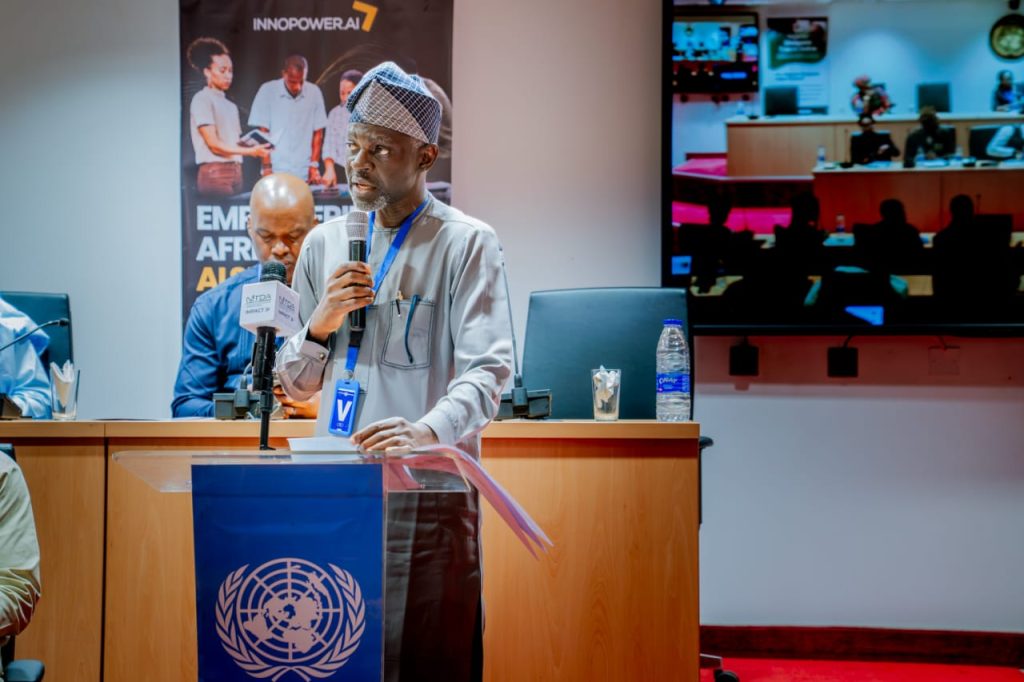
The Agency reaffirmed this commitment during the official launch of the ECOWAS Small Business Coalition (ESBC)-INNOPOWER Free MSMEs AI Master Trainer Programme held at the United Nations House in Abuja, where government officials, development partners and private sector stakeholders gathered to advance AI capacity building for Micro, Small and Medium Enterprises (MSMEs).
Delivering the Director General’s goodwill message, the Director of Digital Development Services, Mr. Oladejo Olawunmi, who represented the Director General of NITDA, Kashifu Inuwa, CCIE, described artificial intelligence as one of the most transformative technologies of the modern era, capable of redefining industries, economies and governance.
He said the launch of the programme reflects a shared commitment by stakeholders to equip MSMEs with the digital competencies required to remain competitive in an increasingly AI-driven global economy.
According to him, AI has evolved beyond a futuristic concept to become a defining force shaping innovation and economic development across the world.
“Artificial Intelligence is no longer a technology of the future but a defining force of the present, reshaping economies, transforming industries and redefining how governments, businesses and societies create value,” he said.
He explained that the Federal Government, through NITDA, is implementing the National Artificial Intelligence Strategy to strengthen AI infrastructure, promote indigenous innovation, accelerate AI adoption across strategic sectors, encourage responsible AI development and establish governance frameworks that ensure the technology benefits society.
Emphasising Nigeria’s ambition in the global AI landscape, Inuwa noted that the country has deliberately chosen to move beyond being a consumer of AI solutions to becoming an active contributor to global AI innovation.
“Rather than remain a passive consumer of AI built elsewhere, we are building the foundations to become an active contributor to the global AI ecosystem,” he stated.
The NITDA boss highlighted several flagship initiatives driving the Agency’s AI agenda, including the National Centre for Artificial Intelligence and Robotics (NCAIR), the Nigeria AI Collective, the N-ATLAS multilingual Large Language Model (LLM), the Digital Literacy for All (DL4ALL) programme and the Three Million Technical Talent (3MTT) initiative.
He explained that these programmes are designed to build local AI capabilities, expand digital literacy, nurture innovation and prepare Nigerians for emerging opportunities in the digital economy.
Speaking on the significance of the MSME AI Master Trainer Programme, Inuwa observed that MSMEs remain the backbone of Nigeria’s economy and can significantly improve their productivity, competitiveness and market reach through the effective adoption of artificial intelligence.
He maintained that Africa’s future in the AI economy would be determined not merely by technology adoption but by strategic investments in human capital, innovation ecosystems and institutional partnerships.
“The countries that lead the AI economy will not be those that consume the most AI solutions, but those that cultivate talent, build infrastructure and create ecosystems where innovation can flourish responsibly,” he remarked.
He commended INNOPOWER and the ECOWAS Small Business Coalition for providing a platform that promotes responsible AI adoption, strengthens collaboration across sectors and empowers entrepreneurs throughout Nigeria and the ECOWAS region.
The Director General also stressed the importance of developing sovereign digital infrastructure, preserving indigenous languages within AI systems and expanding digital literacy to ensure that every Nigerian can participate meaningfully in the country’s digital transformation journey.
Looking ahead, he described the current phase of technological advancement as a defining moment for Africa, urging stakeholders to seize the opportunity to build homegrown AI solutions capable of driving sustainable economic growth across the continent.
“History shows that every technological revolution reshapes the global balance of power. The nations that prosper are not always those with the greatest resources, but those with the foresight to invest in their people and build ecosystems that turn ideas into prosperity,” he concluded.
In his welcome address, the Regional President of the ECOWAS Small Business Coalition (ESBC), Dr. Abdulrashid Yerima, described the MSME AI Master Trainer Programme as a strategic investment in Africa’s human capital aimed at equipping trainers with practical AI knowledge to support entrepreneurs and strengthen small businesses across the region.
He noted that the initiative would expand economic opportunities, stimulate quality job creation and accelerate sustainable industrial development while encouraging participants to leverage the acquired knowledge to transform their enterprises.
Dr. Yerima also called for stronger collaboration among governments, development agencies, financial institutions, academia and the private sector to build an inclusive AI ecosystem capable of enhancing Africa’s competitiveness and driving sustainable economic growth.