 The Minister of Communications, Innovation and Digital Economy, Dr. Bosun Tijani, has challenged Nigerian students to move beyond acquiring knowledge and embrace innovation by developing practical solutions capable of addressing national challenges and driving economic growth.
Speaking during the commissioning and handover of the Renewed Hope–NITDA Innovation Hub at Obafemi Awolowo University (OAU), Ile-Ife, Dr. Tijani described the facility as a strategic investment designed to empower young Nigerians with the tools and opportunities needed to transform ideas into impactful innovations.
The state-of-the-art hub, established by the National Information Technology Development Agency (NITDA) in collaboration with the Renewed Hope Initiative, features advanced laboratories dedicated to Artificial Intelligence (AI), Robotics, Additive Manufacturing, and the Internet of Things (IoT), creating an enabling environment for research, experimentation, and technology-driven entrepreneurship.
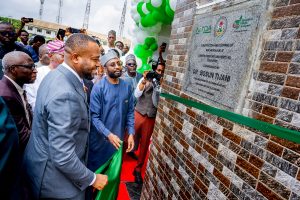
Addressing students, lecturers, alumni, and other stakeholders, the Minister stressed that while world-class infrastructure is important, people remain the true drivers of innovation and progress.
“Innovation does not come from buildings; innovation comes from people,” he said. “Long before these facilities were built, this university had already established itself as a breeding ground for exceptional talent and transformative leaders who have made significant contributions to our nation.”
Dr. Tijani noted that the hub was created to bridge the gap between classroom learning and practical application, enabling students to convert knowledge into tangible products, services, and solutions.
According to him, access to information is no longer a major challenge in today’s digital era, as technology has made knowledge readily available to anyone willing to learn.
“We live in a time when knowledge is everywhere,” he said. “Virtually everything taught in the classroom can be accessed online. The real challenge now is how to apply that knowledge to solve problems, create value, and make meaningful contributions to society.”
The Minister explained that innovation hubs such as the Renewed Hope–NITDA Innovation Hub are intended to provide students with opportunities to experiment, collaborate, innovate, and develop solutions that can positively impact their communities and the nation at large.
“If you want to learn how to build a helicopter today, Generative AI can provide the information,” he stated. “But the real question is whether you can transform that knowledge into action. Centres like this exist to help students make that transition from learning to building.”
He urged students, faculty members, and alumni of the university to take ownership of the facility and ensure that it remains vibrant, accessible, and fully utilised for the benefit of future generations.
Dr. Tijani further emphasized that Nigeria’s ambition to become a leading digital economy will largely depend on the ability of its young people to innovate, create solutions, and harness technology to address real-world challenges.
“Government can provide support and create opportunities, but ultimately, it is your ability to apply knowledge and develop solutions that will determine how far we go as a nation,” he said. “This is an important asset, and it must be protected and maximally utilised to achieve the purpose for which it was established.”
In his remarks, the Vice-Chancellor of Obafemi Awolowo University, Professor Adebayo Simeon Bamire, expressed profound appreciation to Dr. Tijani and the Director General of NITDA, Kashifu Inuwa, CCIE, for their unwavering commitment to advancing digital transformation within the institution.
Professor Bamire highlighted several interventions facilitated by the Minister, including the donation of 50 laptops to students, financial support for student innovators through a $1,000 innovation fund, and a commitment to deploy a 30-kilometre fibre-optic network aimed at improving internet connectivity across the university campus.
He described Dr. Tijani as a committed stakeholder whose interventions continue to create meaningful opportunities for students and strengthen the university’s capacity for innovation and digital learning.
The Vice-Chancellor also commended NITDA’s Director General for the Agency’s sustained support through the provision of critical digital infrastructure and innovation facilities. He noted that the Agency’s interventions have enhanced students’ digital skills, expanded opportunities for research and innovation, and strengthened the university’s readiness for the evolving digital economy.
According to him, the partnership between NITDA and OAU has played a significant role in equipping students with the competencies required to thrive in a technology-driven world.
The Renewed Hope–NITDA Innovation Hub is part of NITDA’s broader efforts to strengthen Nigeria’s innovation ecosystem, promote digital literacy, and provide young Nigerians with access to emerging technologies and hands-on learning opportunities.
By creating an environment that encourages creativity, innovation, and entrepreneurship, the initiative is expected to nurture the next generation of technology leaders, innovators, and problem-solvers who will contribute significantly to Nigeria’s digital transformation agenda and global competitiveness.