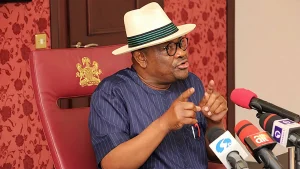
The complex battle for political hegemony in Rivers State has reached a decisive turning point, with the Minister of the Federal Capital Territory, Nyesom Wike, declaring that his political structure has effectively secured absolute control over the state’s governing architecture. Speaking during a high-profile political luncheon in the coastal capital of Port Harcourt, the former Rivers State governor adopted a position of structural triumph, while simultaneously extending an unexpected olive branch to former allies and estranged political opponents, inviting them to reintegrate into what he described as a unified political family.
The minister’s address, which was formally documented in an executive statement released by the Deputy Director of Press in the Office of the FCT Minister, Rabi Umar, carried a dual message of internal reconciliation and external defense. Wike issued a stern, metaphorical warning to external political actors against meddling in the domestic affairs of Rivers State, asserting that any outsourced attempt to undermine the state’s internal stability would be met with fierce, unyielding resistance.
This public declaration serves as a major milestone following a prolonged, bitter institutional crisis that triggered a profound fracturing between Wike and his handpicked successor, Siminalayi Fubara. The high-stakes confrontation between the two statesmen has been widely characterized by political analysts as an existential struggle for control over the financial and political machinery of the oil-rich state. What began as a strategic succession arrangement shortly after the 2023 gubernatorial transition rapidly devolved into an open power contest, fueled by sharp disagreements over cabinet appointments, the allocation of state resources, and control over the executive organs of the governing party structure.
As the political landscape fractured, the Rivers State House of Assembly transformed into a primary theater of war, splitting into two fiercely antagonistic legislative factions. One bloc maintained absolute loyalty to Wike’s established network, while a rival group backed the embattled governor, a division that plunged the state into months of deep institutional paralysis and systemic uncertainty. The balance of power increasingly tilted in favor of the FCT Minister’s camp following a sequence of critical judicial interventions and court rulings that authenticated the legal legitimacy of the lawmakers aligned with Wike.
At the absolute zenith of the political standoff, the pro-Wike legislative majority escalated the offensive by initiating formal impeachment proceedings against Fubara and his deputy on allegations of gross misconduct, an action that pushed the state to the brink of a major civil crisis. Recognizing the potential for total systemic breakdown, President Bola Tinubu intervened directly by declaring a state of emergency within the territory. This extraordinary executive action resulted in the six-month suspension of Fubara, Deputy Governor Ngozi Odu, and the entire elected membership of the state House of Assembly, resetting the political chessboard.
The root of the hostility stems from competing interpretations of loyalty and executive autonomy within the political coalition. Wike has frequently accused his successor of systematically alienating the foundational structure that funded and engineered his rise to the governorship, while Fubara has consistently defended his actions as a necessary pursuit of administrative independence required to govern the state without external oversight. Caught in a tightening political vise and facing a loss of institutional leverage over the party machinery, Fubara ultimately withdrew from the Rivers State All Progressives Congress governorship primaries ahead of the 2027 electoral cycle. The suspended governor framed his exit not as an act of weakness or capitulation, but as a voluntary, calculated sacrifice aimed at lowering the political temperature and safeguarding the state from further structural destabilization.
Reflecting on this dramatic sequence of events at the Port Harcourt luncheon, Wike confidently asserted that the question of who dictates the political direction of the state has been permanently settled, rendering future gubernatorial speculation obsolete. He emphasized that his structure remains fully intact and firmly in control, dismissing the possibility of any political miracle or sudden maneuver disrupting their established position. The minister attributed the enduring strength of his camp to a highly resilient “rainbow coalition” that continues to command deep-seated grassroots loyalty across every local government area in Rivers State.
Yet, alongside this display of political dominance, the minister shifted into a surprisingly conciliatory tone, publicly announcing that he had chosen to forgive every individual who had opposed or actively sabotaged his structure during the height of the crisis. He issued an open call for former associates, party defectors, and estranged allies to return to the fold, arguing that prolonged political warfare yields no tangible benefits for the ordinary citizens of Rivers State. Wike urged these figures to return home with a spirit of sincerity, noting that while the season of aggressive politics and public attacks had passed, his camp remained highly vigilant, organized, and entirely willing to cooperate with returning members without selfishness.
However, this willingness to reconcile stopped abruptly at the state borders. Wike established a firm boundary regarding external interference, warning outside political actors to stay away from the state’s internal dynamics. Without identifying specific individuals or regional blocs, he warned that outsiders seeking to manipulate or destroy the political harmony of Rivers State would face severe consequences, using vivid language to illustrate that those who attempt to intervene would be burned by the resulting political fire.
Shifting his focus to his current federal assignment, Wike utilized the platform to showcase the massive infrastructural transformations occurring in the nation’s capital under his ministerial watch. He announced that the FCT Administration is launching an extensive, 31-day project commissioning marathon specifically organized to celebrate the third anniversary of President Bola Ahmed Tinubu’s administration.
According to the minister, this month-long rollout will feature the formal unveiling of major arterial road networks, heavy public infrastructure assets, and sweeping urban renewal initiatives across Abuja’s municipal area. Crediting the President’s expansive developmental vision and unwavering backing for making these capital-intensive projects a reality, Wike challenged critics and political detractors to match the unprecedented scale of governance and structural engineering currently redefining the Federal Capital Territory.