


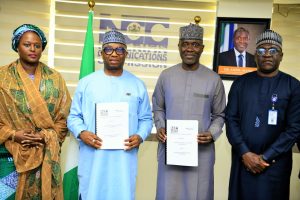
As Nigeria’s digital ecosystem continues to grow at an accelerated pace, the Nigerian Communications Commission (NCC) and the Nigerian Data Protection Commission (NDPC) have entered into a strategic partnership to strengthen data privacy and protection within the telecommunications sector.
The partnership was formalised through the signing of a Memorandum of Understanding (MoU), which sets out a clear framework for cooperation between both agencies. The agreement is designed to enhance regulatory coordination, improve enforcement of data protection standards, and ensure greater accountability in the handling of citizens’ personal information across the communications industry.
Speaking on the significance of the collaboration, the Executive Vice Chairman and Chief Executive Officer of the NCC, Dr. Aminu Maida, described data protection as central to the future of the communications sector. He noted that as Nigeria embraces digital transformation and emerging technologies such as artificial intelligence, the responsible regulation of data will be critical to sustaining public trust, innovation, and economic growth.
Dr. Maida reaffirmed the NCC’s commitment to working with the NDPC to safeguard the privacy rights of Nigerians while supporting the development of a robust and forward-looking telecoms infrastructure. He highlighted the sector’s rapid evolution, pointing out that Nigeria has grown from roughly 500,000 telephone lines to more than 170 million active connections, a milestone that reflects the Commission’s role in enabling connectivity, enterprise, and national development.
He explained that the next wave of growth will be driven by data-powered technologies, particularly artificial intelligence, which relies heavily on user-generated data. According to him, data originates from individuals, belongs to them, and carries rights that must be protected through awareness and strong regulation.
Dr. Maida warned that when citizens are unaware of the value and ownership of their data, it becomes vulnerable to exploitation. He stressed that many digital platforms labelled as “free” often operate by monetising user data, sometimes without clear consent or benefit to the data owners.
“The future is data. If we do not get the principles of how we govern it right, even our national sovereignty could be undermined,” he said.
He further described data as a strategic national resource, noting that for artificial intelligence to deliver meaningful benefits to Nigeria, the country must continue to generate locally relevant data within a secure and trusted regulatory environment.
Also speaking at the event, the National Commissioner of the NDPC, Dr. Vincent Olatunji, described the MoU as a critical step toward strengthening the protection of Nigerians’ personal data. He emphasized that effective data regulation requires collaboration with sector-specific regulators, particularly in highly technical industries such as telecommunications.
Dr. Olatunji clarified that the NDPC is not seeking to replace the NCC’s mandate but to complement it through shared responsibility and regulatory synergy. He stressed the importance of immediate implementation, noting that the agreement is intended to deliver real outcomes rather than remain a ceremonial document.
He added that coordination and collaboration are core principles guiding the NDPC’s work, expressing confidence that the partnership would improve data governance, enhance regulatory efficiency, and build capacity across both institutions.
Given their overlapping responsibilities, both the NCC and NDPC acknowledged the need to streamline regulatory processes to avoid duplication and ensure clarity in the protection of data within the communications sector. The MoU, they noted, represents a unified approach to securing personal data while supporting innovation and the continued growth of Nigeria’s digital economy.