
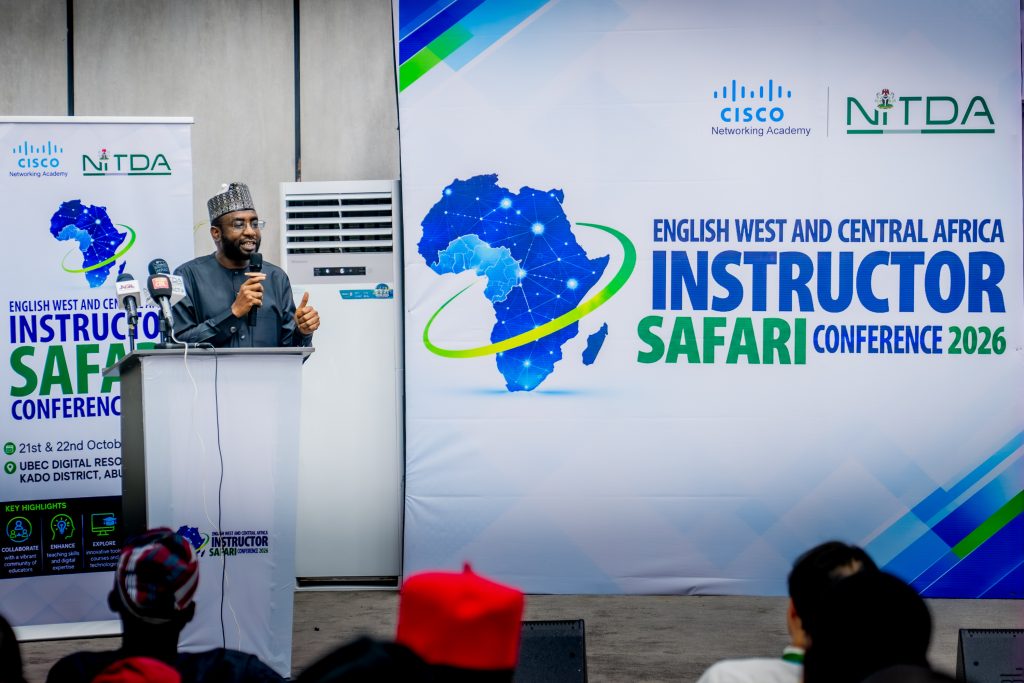
 The Director General of the National Information Technology Development Agency (NITDA), Kashifu Inuwa, has called for a fundamental shift in Nigeria’s education system from examination-oriented learning to practical, industry-relevant digital skills development to prepare young Nigerians for opportunities in the rapidly evolving artificial intelligence-driven global economy.
Inuwa made the call at the English West and Central Africa Instructor Safari Conference 2026 in Abuja, where he emphasised that the future of work would increasingly favour individuals equipped with problem-solving abilities, technological competence, adaptability and a commitment to lifelong learning.
According to him, educational institutions must move beyond producing graduates with academic qualifications to developing individuals capable of applying knowledge to real-world challenges, creating innovative solutions and contributing meaningfully to national economic growth.
Drawing from his personal experience as an alumnus of Cisco Networking Academy, Inuwa recounted how practical digital training shaped his professional development, enabling him to progress from website development to network engineering and subsequently explore broader opportunities in the technology sector.
He explained that his experience demonstrated the transformative potential of skills-based education, stressing that acquiring practical competencies was more valuable than merely passing examinations.
The NITDA boss urged instructors to place greater emphasis on hands-on learning, critical thinking, root-cause analysis, systems thinking and leadership development, describing these competencies as essential for navigating the disruptions associated with artificial intelligence and other emerging technologies.
Citing the World Economic Forum’s Future of Jobs Report 2025, Inuwa noted that technological transformation and other labour-market trends could create approximately 170 million new jobs globally by 2030 while displacing about 92 million existing roles.
He maintained that these projections reinforced the urgency of equipping Nigerians with relevant digital capabilities, encouraging continuous upskilling and building a workforce capable of adapting to technological changes.
Inuwa described digital literacy as a fundamental requirement for national development, arguing that technological competence had become as essential as traditional literacy and numeracy.
He linked the development of a digitally skilled population to President Bola Ahmed Tinubu’s ambition of building a $1 trillion Nigerian economy by 2030, noting that achieving the target would require significant investments in human capital, innovation and technology-driven productivity.
Highlighting ongoing government interventions, he disclosed that NITDA had partnered with Nasarawa State University to pilot digital literacy as a General Studies course, with the objective of exposing students across different academic disciplines to essential technology skills.
He also pointed to broader efforts to integrate digital literacy into formal education through curriculum reforms, teacher training and strategic partnerships with educational institutions and technology organisations.
Inuwa commended the Federal Government for prioritising human capital development and acknowledged Cisco Networking Academy’s longstanding contribution to digital skills acquisition through its partnerships with Nigerian universities and other training institutions.
He challenged educators to produce graduates who possess not only theoretical knowledge but also the technical expertise, creativity and problem-solving capabilities required to compete in the modern workforce.
Also speaking at the conference, the Minister of Education, Dr. Tunji Alausa, reaffirmed the Federal Government’s commitment to repositioning Nigeria’s education system through digital transformation, practical learning and stronger collaboration with industry stakeholders.
Alausa disclosed that the national curriculum had been updated to introduce digital technology at the primary school level, while NITDA and the Universal Basic Education Commission (UBEC) were supporting teacher training and the provision of digital learning resources.
He emphasised the need to strengthen partnerships among government agencies, Cisco Networking Academy, educational institutions and development organisations to ensure that digital education translates into improved employability and economic opportunities.
The Minister urged Cisco to deepen its engagement with colleges of education, federal technical colleges and state technical colleges, particularly in providing practical training, professional certifications, mentorship and internship opportunities.
According to him, bridging the gap between classroom instruction and workplace requirements is critical to preparing young Nigerians for emerging careers in technology and other sectors.
Alausa further advocated the integration of digital literacy into General Studies programmes across tertiary institutions, noting that students pursuing non-technology disciplines must also acquire the competencies required to function effectively in a digital economy.
On digital inclusion, he stressed the importance of expanding access to technology education for girls, persons with disabilities, rural communities and economically disadvantaged learners.
He revealed that the Ministry of Education had collaborated with the Nigerian Communications Commission (NCC) to introduce zero-rated access to educational content, an initiative designed to reduce connectivity costs and improve access to digital learning resources.
The Minister also expressed confidence in the capacity of Nigerian technology entrepreneurs to develop innovative solutions, reiterating the government’s commitment to supporting homegrown software and strengthening the country’s digital ecosystem.
Providing insights into Cisco Networking Academy’s impact, Cisco West Africa General Manager, Abdulaziz Saeed, disclosed that approximately 1.4 million Nigerian learners had benefited from the programme since its introduction in 1997.
He explained that the initiative had reached about 30 million students across 105 countries, with approximately 6.5 million active learners recorded globally in fiscal year 2026.
In Nigeria, the programme currently has about 338,000 active students, supported by 696 instructors and partnerships with 369 academic institutions, according to figures presented at the conference.
Saeed identified artificial intelligence, cybersecurity, cloud computing and software programming as critical skills that would shape future employment opportunities and enhance the competitiveness of young professionals.
He stressed that expanding access to digital infrastructure, quality education and industry-aligned training would require sustained collaboration between governments, academic institutions, development partners and the private sector.
The conference also highlighted initiatives aimed at increasing women’s participation in technology, improving employment opportunities for graduates and ensuring that underserved communities benefit from the digital transformation agenda.
The discussions reinforced the growing consensus that Nigeria’s transition to an AI-driven economy will depend not only on investments in technology infrastructure but also on its ability to develop a skilled, adaptable and innovative workforce capable of translating digital knowledge into economic value.