
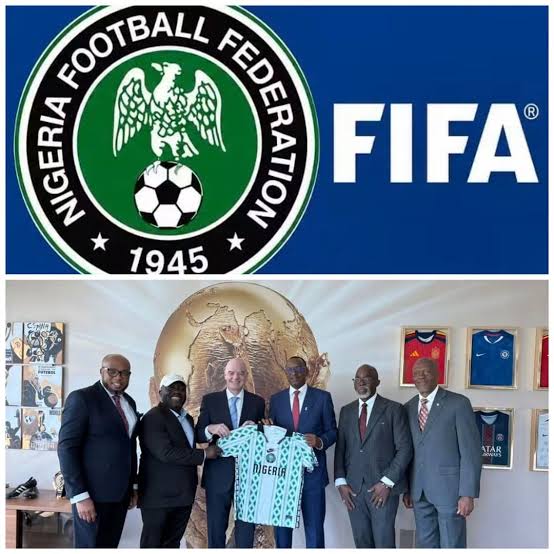
Nigerian football has a new chapter to navigate. On Thursday, FIFA approved the appointment of a normalisation committee to run the Nigeria Football Federation (NFF) until fresh elections can be held. The news led Friday’s sports coverage, and it follows months of uncertainty over who is actually in charge of the game. Here is what FIFA has confirmed, how the federation got here, what such committees typically do, and the questions that remain open.
What FIFA approved
The NFF said the Bureau of the FIFA Council approved the committee on Thursday, and that FIFA and the Confederation of African Football (CAF) will jointly appoint its members. The decision came in a letter signed by FIFA Secretary General Mattias Grafström and addressed to NFF acting general secretary Dr Emmanuel Ikpeme.
Several terms matter. The letter says the committee’s mandate ends once it has completed its tasks, and in any case no later than May 31, 2027. It also says no member of the committee will be eligible, under any circumstances, for the positions to be filled in the coming NFF elections. In the meantime, the NFF secretariat will keep handling day-to-day administration until the committee members are appointed. FIFA has not yet named the members or published a detailed mandate. FIFA authorises Normalisation Committee to oversee Nigerian football +3
How the federation reached this point
The immediate trigger was a leadership collapse. NFF president Ibrahim Musa Gusau, general secretary Mohammed Sanusi and members of the executive committee resigned on August 27. The resignations came amid widespread criticism of the administration of Nigerian football.
International bodies then stepped in. A joint FIFA and CAF delegation visited Nigeria in September to engage stakeholders and assess options for resolving the crisis. FIFA president Gianni Infantino later said the discussions covered institutional, governance and developmental issues, including ways to strengthen Nigeria’s football structures and create more opportunities for young players. Sporting Tribune also links to an earlier report that FIFA and CAF had suspended the NFF electoral process pending assessment, which suggests the committee is the next stage of a process already in motion.
Normalisation committees are a familiar FIFA tool. They are used in exceptional circumstances to oversee football associations during governance instability, and to restore regular administration through a defined transition. Typically, they manage the association’s daily affairs, address governance problems, review its statutes and organise elections for new leadership.
For Nigerian football, that could mean three practical things: someone with clear authority to make decisions while the elected executive is absent, a review of the rules under which the federation operates, and a route back to an elected board. FIFA has not yet said how much of that mandate this committee will carry, so those remain expectations drawn from how such bodies usually work, not confirmed terms.
Why the eligibility bar matters
The rule barring committee members from contesting the next elections is worth noticing. As an analytical reading, it appears designed to keep the caretakers focused on running a credible transition instead of positioning themselves for office. It also narrows the field of people FIFA and CAF can draw on, since anyone who wants to run for a post in the new executive cannot be part of the body organising the vote.
Questions still open
- Who sits on the committee? FIFA and CAF have said they will choose members “as soon as possible,” but no names have been published.
- Who chairs it, and what powers does it hold relative to the secretariat?
- When will elections happen? The May 31, 2027 date is a ceiling, not a schedule, and the committee can finish sooner.
- What happens to the statutes? Reforms to the federation’s rules are a typical normalisation task, but no details have been announced.
Headlines also differ in tone. One outlet describes FIFA and CAF “taking control” of Nigerian football, while the letter’s own language, as quoted by several papers, speaks of a committee that oversees the federation pending elections. Readers should treat the letter’s wording as the better guide.
What to watch
The next milestone is the naming of the committee. After that, supporters should look for an announced timetable for elections, any statement on how the committee will work with the NFF secretariat, and how clubs, state associations and other stakeholders respond. Until FIFA and CAF publish those details, the clearest facts are the ones in the letter: a caretaker body, a hard end date of May 31, 2027, and a rule keeping its members out of the race that follows.