
The Federal Capital Territory of Abuja serves as the engine room where national technology guidelines are drafted, debated, and approved. However, Lagos remains the ultimate proving ground where those digital policies either achieve real commercial scale or collapse. Following the opening Government Leadership & AI Summit in Abuja, the second edition of GITEX Nigeria moved directly to the country’s commercial capital for the Tech Expo & Future Economy Conference.
This change of scenery brought an immediate shift in focus and tone. While Abuja provided the regulatory framework for the country’s technological ambitions, Lagos demanded practical proof, verifiable physical assets, and clear execution pathways.
Global tech leaders, venture capitalists, and corporate executives did not travel to West Africa simply to listen to familiar speeches about youth demographics or mobile phone adoption rates. The early phase of celebrating broad African technology potential has officially ended. Discussions held at the Landmark Event Centre in Lagos focused on concrete operational metrics, including stable electrical grids, underground fiber-optic networks, and the national capacity required to build and maintain artificial intelligence hardware.
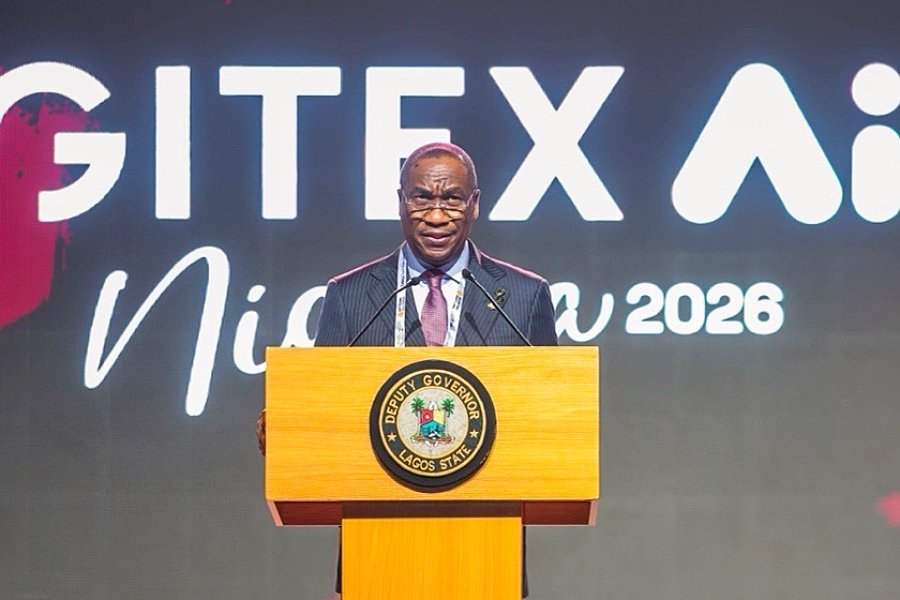
Addressing the gathering on behalf of Governor Babajide Sanwo-Olu, Lagos State Deputy Governor Dr. Kadri Obafemi Hamzat presented the state’s position with direct clarity. He emphasized that bringing GITEX to Nigeria was neither a gesture of diplomatic goodwill nor a request for foreign aid.
Exhibitions follow markets Hamzat told the audience of international representatives, public officials, and institutional investors. “And markets follow scale, capital, and talent.
Dr. Hamzat defined the state’s long-term objectives in clear competitive terms. He stated that Lagos aims to be recognized not just as the commercial capital of Nigeria, but as the principal innovation capital of the entire African continent. He added that such a standing cannot be claimed through declarations alone; it must be systematically earned through infrastructure development, human talent, solid policymaking, and consistent execution.
Lagos commands global commercial attention because of its sheer scale and economic influence. Economic performance across this megacity directly affects the financial momentum of a continental market that is approaching 1.4 billion people.
Recognized as the world’s fastest-growing technology hub in the 2025 Dealroom Global Tech Ecosystem Index, Lagos achieved an 11.6-fold increase in total enterprise value, reaching $15.3 billion and outperforming 287 cities across 69 nations.
Despite these established milestones, past accomplishments do not eliminate the operational obstacles currently facing expanding technology businesses.
The core of the state government’s presentation involved an open acknowledgment of the physical and infrastructural deficits that continue to limit commercial productivity.
Rather than ignoring the systemic shortages affecting daily business operations, Dr. Hamzat directly addressed the national electricity supply. Power costs remain one of the heaviest operating expenses for African enterprises, consuming corporate margins through expensive diesel generators and fragmented off-grid setups.
Lagos State is moving to solve this issue through state-level legal decentralization. Operating under the Lagos State Electricity Law and utilizing the regulatory powers of the Lagos State Electricity Regulatory Commission, the state government has transferred regulatory control over its internal electricity market away from federal agencies.
By issuing operational licenses to independent power producers across power generation, embedded mini-grids, and local distribution networks, the state government is executing formal power purchase agreements. These agreements aim to secure an additional 4,000 megawatts of dedicated power capacity, with a target of achieving 97.5% grid reliability within three years.
In parallel with energy reforms, significant civil infrastructure work is taking place beneath the city’s roadways. To protect telecom operators from heavy capital expenditures, the state government established a unified open-access duct framework governed by a strict “dig-once” rule, managed directly by the Lagos State Infrastructure Maintenance and Regulatory Agency.
Having already installed 3,000 kilometers of municipal fiber-optic cables, the state is expanding this network toward a 6,000-kilometer grid. This underground network connects directly to transatlantic subsea data cables landing along the Atlantic coastline. Under this framework, new telecommunications companies no longer need to repeatedly excavate public roads to lay individual cables, as the state government has absorbed that foundational infrastructure cost into public utility systems.