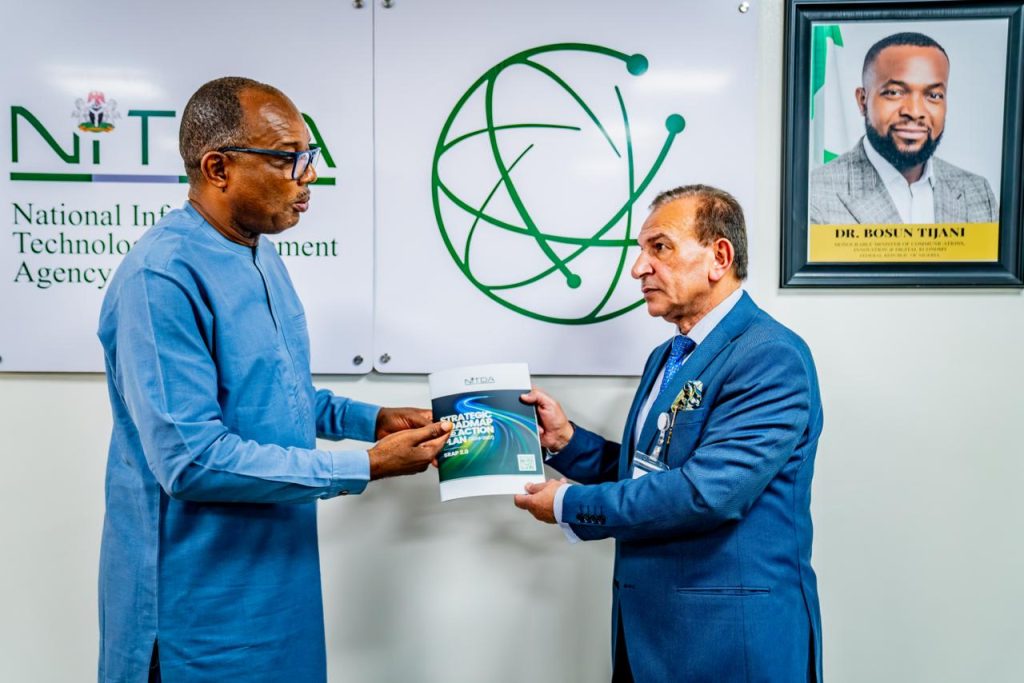
The National Information Technology Development Agency (NITDA) has commenced high-level discussions with Trust Stamp, a NASDAQ-listed global technology firm, to explore strategic collaboration aimed at reinforcing Nigeria’s digital trust architecture and accelerating innovation within the digital economy.
The meeting, chaired by NITDA’s Director-General, Kashifu Inuwa Abdullahi, centred on identifying areas of cooperation that align with Nigeria’s broader digital transformation objectives and the Agency’s mandate to build a secure, inclusive and innovation-driven digital ecosystem.
Inuwa stressed that trust remains the backbone of any thriving digital economy. He noted that robust cybersecurity systems and secure digital frameworks are essential to fostering innovation, stimulating economic growth and advancing national development. According to him, strengthening public confidence in digital platforms is critical to accelerating adoption and unlocking value across multiple sectors.
He reiterated NITDA’s role as a regulatory body focused on creating enabling, forward-looking policies that encourage innovation rather than favour specific technologies. Government interventions, he explained, are structured to stimulate markets, open up opportunities and empower businesses and citizens to participate meaningfully in the digital space.
The Director-General also reaffirmed Nigeria’s openness to investments that enhance digital infrastructure and improve service delivery, emphasising that sustainable development is best achieved through active private sector participation within a supportive regulatory framework. He called for sustained engagement to ensure alignment with national priorities and seamless integration into Nigeria’s evolving digital ecosystem.
On his part, Trust Stamp’s Vice President, Jonathan Pasha, highlighted the company’s global expertise in identity verification and trust technologies. He described the firm’s approach as collaborative and ecosystem-driven, aimed at delivering long-term value through partnerships with governments and industry stakeholders.
Pasha referenced the company’s ongoing activities in Nigeria, including collaboration with a telecommunications provider to strengthen SIM swap protection and fraud detection mechanisms. He also showcased Trust Stamp’s biometric tokenisation solution, which transforms biometric data into secure, privacy-preserving digital tokens that enable identity verification without exposing sensitive personal information.
According to him, the technology supports secure authentication, fraud prevention, financial inclusion and asset tokenisation initiatives. It is also designed to operate efficiently in low-connectivity environments and on entry-level devices, thereby expanding access to secure digital services.
Both NITDA and Trust Stamp expressed readiness to deepen technical-level engagements to define specific collaboration pathways that align with Nigeria’s national digital priorities.
NITDA reaffirmed its commitment to building a secure and trusted digital economy through strategic partnerships, strong regulatory frameworks and initiatives that drive innovation, inclusion and sustainable growth.